Consider the following database table named Consider the following SQL query:…
2017

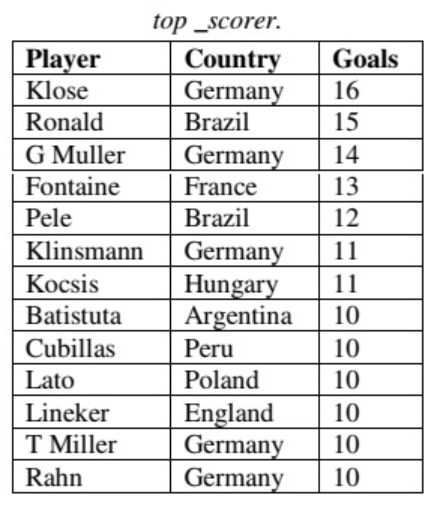
Consider the following database table named 

image.png

Consider the following SQL query:

SELECT ta.player FROM top_scorer AS ta

WHERE ta.goals >ALL (SELECT tb.goals

FROM top_scorer AS tb

WHERE tb.country = 'Spain')

AND ta.goals > ANY (SELECT tc.goals

FROM top_scorer AS tc

WHERE tc.country='Germany')

The number of tuples returned by the above SQL query is ______

Attempted by 83 students.

Show answer & explanation

Correct answer: 7

Step 1: Evaluate the subquery for Spain.

The subquery that selects goals for country = 'Spain' returns an empty set because there are no players from Spain in the table.

Important note: a comparison using ALL against an empty set is vacuously true, so ta.goals > ALL (empty set) is true for every row.

Step 2: Evaluate the subquery for Germany.

  • The Germany goals returned are: 16, 14, 11, 10.

The condition ta.goals > ANY (these Germany goals) means ta.goals must be greater than at least one of those values. That is true exactly when ta.goals > 10, so ta.goals must be at least 11.

Step 3: Combine both conditions.

  • The ALL condition is true for every row (from Step 1).

  • So the rows that satisfy the WHERE clause are those with goals >= 11.

Players with goals >= 11 are: Klose (16), Ronald (15), G Muller (14), Fontaine (13), Pele (12), Klinsmann (11), and Kocsis (11).

Final answer: The query returns 7 tuples.

A video solution is available for this question — log in and enroll to watch it.

Explore the full course: Gate Guidance By Sanchit Sir