Consider a database with three relation instances shown below. The primary…
2006
Consider a database with three relation instances shown below. The primary keys for the Drivers and Cars relation are did and cid respectively and the records are stored in ascending order of these primary keys as given in the tables. No indexing is available in the database.
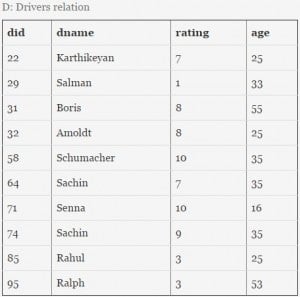
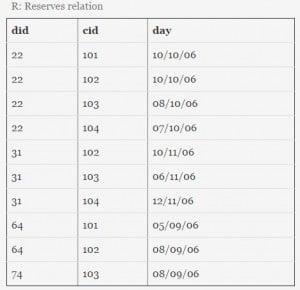
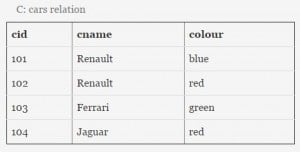
SELECT D.dname FROM Drivers D WHERE D.did IN
(
SELECT R.did FROM Cars C, Reserves R WHERE R.cid = C.cid AND C.colour = 'red'
INTERSECT
SELECT R.did FROM Cars C, Reserves R WHERE R.cid = C.cid AND C.colour = 'green'
);
Let n be the number of comparisons performed when the above SQL query is optimally executed. If linear search is used to locate a tuple in a relation using primary key, then n lies in the range
Answer: B. 44 - 48 — Simple aur proper explanation: Comparison CalculationWe calculate the comparisons step by step. 1. First inner query: Red cars SELECT R.did FROM Cars C,…
- A.
36 - 40
- B.
44 - 48
- C.
60 - 64
- D.
100 - 104
Attempted by 25 students.
Show answer & explanation
Correct answer: B
Simple aur proper explanation:
Comparison Calculation
We calculate the comparisons step by step.
1. First inner query: Red cars
SELECT R.did
FROM Cars C, Reserves R
WHERE R.cid = C.cid AND C.color = 'red'
First, we scan all 4 tuples of the Cars relation to find red cars.
Comparisons = 4There are 2 red cars. For each red car, all 10 tuples of Reserves are checked to match R.cid = C.cid.
Comparisons = 2 × 10 = 20
So, for the first inner query:
4 + 20 = 24 comparisons
The resulting did values are:
{22, 22, 31, 31, 64}
After removing duplicates:
{22, 31, 64}
2. Second inner query: Green cars
SELECT R.did
FROM Cars C, Reserves R
WHERE R.cid = C.cid AND C.color = 'green'
Scan all 4 tuples of Cars to find green cars.
Comparisons = 4There is 1 green car, so all 10 tuples of Reserves are checked.
Comparisons = 1 × 10 = 10
So, for the second inner query:
4 + 10 = 14 comparisons
The resulting did values are:
{22, 31, 74}
3. Intersection of the two sets
First set:
{22, 31, 64}
Second set:
{22, 31, 74}
Common values are:
{22, 31}
Using linear search:
For 22, it matches on the first comparison → 1 comparison
For 31, it matches on the second comparison → 2 comparisons
For 74, all 3 values of the first set are checked → 3 comparisons
So:
1 + 2 + 3 = 6 comparisons
4. Finding these drivers in the Drivers table
Now we need to find did = 22 and did = 31 in the Drivers table using linear search.
22 is found on the first try → 1 comparison
31 is found on the third try → 3 comparisons
So:
1 + 3 = 4 comparisons
Total Comparisons
First inner query = 24
Second inner query = 14
Intersection = 6
Drivers table search = 4
24+14+6+4=48 {24 + 14 + 6 + 4 = 48}
Therefore, the total number of comparisons is 48, so Option B is the correct answer.