Consider the following relations X(S, Si, C) and Y(S, P, D) . Which of the…
2023
Consider the following relations X(S, Si, C) and Y(S, P, D) .
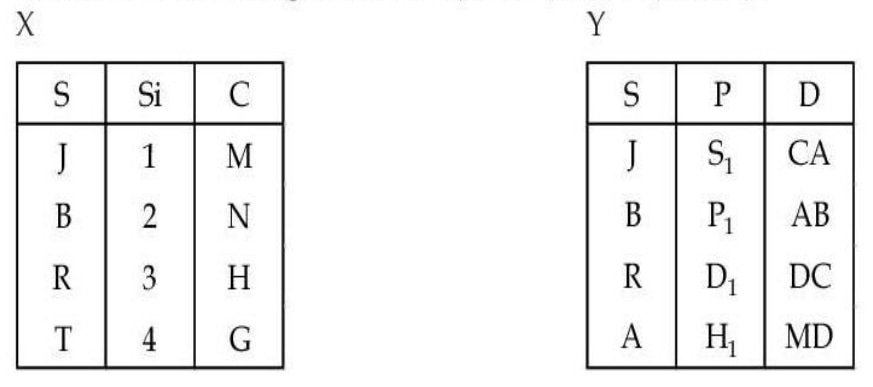
Which of the following join is used to get all the tuples of relation X and Y with Null values of corresponding missing values ?
Answer: D. Full outer join — Answer: Full outer join Explanation: A full outer join returns all rows from both relations and fills NULL for attributes from the other relation when no…
- A.
Left outer join
- B.
Right outer join
- C.
Natural join
- D.
Full outer join
Attempted by 456 students.
Show answer & explanation
Correct answer: D
Answer: Full outer join
Explanation: A full outer join returns all rows from both relations and fills NULL for attributes from the other relation when no matching tuple exists.
Join key: the common attribute S is used to match tuples.
Tuples present only in relation X will appear with NULLs for the attributes from relation Y (P, D).
Tuples present only in relation Y will appear with NULLs for the attributes from relation X (Si, C).
Tuples present in both relations will include values from both sides.
Resulting rows (S, Si, C, P, D):
S = J: Si = 1, C = M, P = S1, D = CA
S = B: Si = 2, C = N, P = P1, D = AB
S = R: Si = 3, C = H, P = D1, D = DC
S = T: Si = 4, C = G, P = NULL, D = NULL
S = A: Si = NULL, C = NULL, P = H1, D = MD
Why other joins do not satisfy the requirement: a join that returns only rows from the left relation misses tuples present only in the right; a join that returns only rows from the right misses tuples present only in the left; a natural/inner join returns only matching tuples and excludes non-matching ones.
A video solution is available for this question — log in and enroll to watch it.