Let Q denote a queue containing sixteen numbers and S be an empty stack.…
2016
Let Q denote a queue containing sixteen numbers and S be an empty stack. Head(Q) returns the element at the head of the queue Q without removing it from Q. Similarly, Top(S) returns the element at the top of S without removing it from S. Consider the algorithm given below.
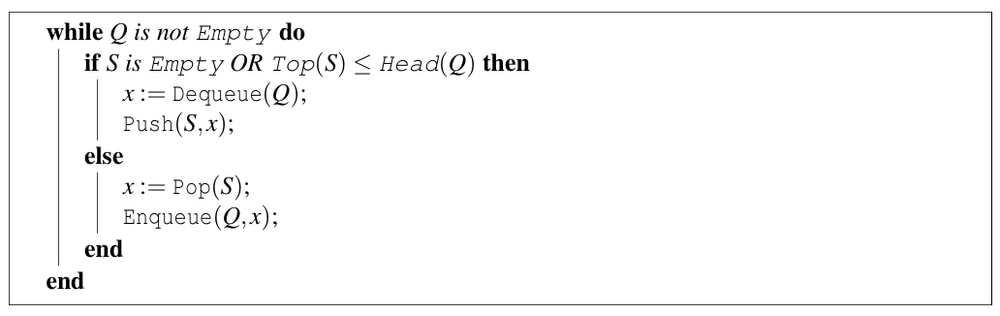
The maximum possible number of iterations of the while loop in the algorithm is ___________ .
Attempted by 118 students.
Show answer & explanation
Correct answer: 256
We want the maximum number of iterations of the while loop when the queue initially has n = 16 elements.
Let D be the number of Dequeue operations and E be the number of Enqueue operations. Each iteration performs exactly one Dequeue or one Enqueue, so the total number of iterations is T = D + E.
Track the queue size: starting size is n, and final size is 0, so n - D + E = 0. Hence D = n + E and therefore T = n + 2E. To maximize T we must maximize E.
Bound on E: every Enqueue occurs when an element a is popped from the stack because a is greater than the current head element b of the queue. Associate that Enqueue with the unordered pair {a,b} (with a > b).
No unordered pair of distinct elements can be associated more than once, because once a is moved behind b in the queue their relative order (a after b) prevents the same comparison-caused Enqueue for that pair again. Therefore E is at most the number of distinct unordered pairs among n elements, which is n(n-1)/2.
Thus E_max = n(n-1)/2. For n = 16 this gives E_max = 16*15/2 = 120.
Plug into T = n + 2E to get T_max = 16 + 2*120 = 256, which equals n^2.
Answer: 256
A video solution is available for this question — log in and enroll to watch it.