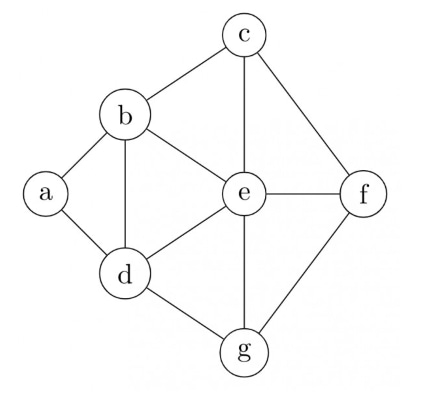
Consider the following sequence of nodes for the undirected graph given below.…

2008

Consider the following sequence of nodes for the undirected graph given below.


a b e f d g c

a b e f c g d

a d g e b c f

a d b c g e f

A Depth First Search (DFS) is started at node a. The nodes are listed in the order they are first visited. Which all of the above is (are) possible output(s)?

image.png

  1. A.

    1 and 3 only

  2. B.

    2 and 3 only

  3. C.

    2, 3 and 4 only

  4. D.

    1, 2, and 3

Attempted by 158 students.

Show answer & explanation

Correct answer: B

Answer: the possible DFS outputs are the sequences "a b e f d g c" and "a d g e b c f".

Reasoning (how to get each valid sequence):

  • To obtain "a b e f d g c": choose at node a the neighbor b before d. At b choose e before other neighbors. From e go to f. From f choose d and then from d go to g. After finishing that branch, backtrack and visit c last. This obeys DFS rules (always move to an unvisited neighbor; backtrack only when none remain).

  • To obtain "a d g e b c f": choose at node a the neighbor d before b. From d move to g first, then backtrack and visit e, then continue to b. From b go to c, and finally to f. This is also a valid DFS pre-order given an appropriate ordering of each node's adjacency list.

Why the other two sequences are not possible:

  • "a b e f c g d" is not possible because it requires visiting c (from f) and g before visiting d, while the connectivity of the graph ensures that d would have been discovered earlier in the DFS branch containing f (or would need backtracking that contradicts the required order). The necessary interleaving of discoveries cannot occur in a standard DFS pre-order.

  • "a d b c g e f" is not possible because after going a -> d -> b, DFS must explore b's reachable subtree before returning; the particular ordering that places g and e after c but before f conflicts with the immediate discovery rule and required backtracking points, so no adjacency ordering yields that exact visit sequence.

Summary: valid DFS pre-orders depend on the order in which each node explores its neighbors. Sequences "a b e f d g c" and "a d g e b c f" can be produced by appropriate neighbor orderings; the other two cannot because they violate DFS discovery/backtracking constraints given the graph's connections.

A video solution is available for this question — log in and enroll to watch it.

Explore the full course: Gate Guidance By Sanchit Sir