Host A is sending data to host B over a full duplex link. A and B are using…

2003

Host A is sending data to host B over a full duplex link. A and B are using the sliding window protocol for flow control. The send and receive window sizes are 5 packets each. Data packets (sent only from A to B) are all 1000 bytes long and the transmission time for such a packet is 50 µs. Acknowledgement packets (sent only from B to A) are very small and require negligible transmission time. The propagation delay over the link is 200 us. What is the maximum achievable throughput in this communication?
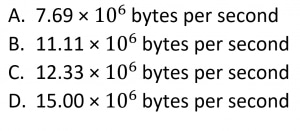
  1. A.

    A

  2. B.

    B

  3. C.

    C

  4. D.

    D

Attempted by 92 students.

Show answer & explanation

Correct answer: B

Solution summary: compute the maximum throughput using the sliding-window limit.

  • Step 1 — Compute RTT:

    RTT = 2 × propagation delay + data transmission time (ACK transmission time is negligible).

    RTT = 2 × 200 µs + 50 µs = 450 µs.

  • Step 2 — Compute maximum in-flight data allowed by the window:

    In-flight bytes = window size × packet size = 5 × 1000 bytes = 5000 bytes.

  • Step 3 — Compute window-limited throughput:

    Throughput = in-flight bytes / RTT = 5000 bytes / 450 µs ≈ 11.111… × 10^6 bytes/s.

  • Step 4 — Check link capacity (not limiting here):

    Link raw capacity = packet size / packet transmission time = 1000 bytes / 50 µs = 20 × 10^6 bytes/s, which is greater than the window-limited throughput.

Final answer: the maximum achievable throughput is approximately 11.11 × 10^6 bytes per second.

A video solution is available for this question — log in and enroll to watch it.

Explore the full course: Gate Guidance By Sanchit Sir