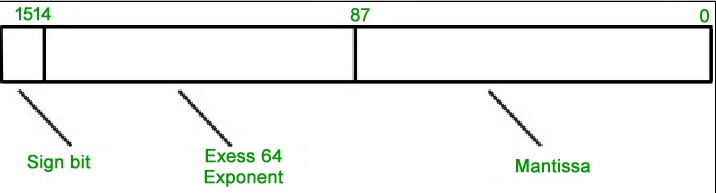
Consider the following floating point format Mantissa is a pure fraction in…
2005

Consider the following floating point format

GATECS2005Q84A

Mantissa is a pure fraction in sign-magnitude form. The normalized representation for the above format is specified as follows. The mantissa has an implicit 1 preceding the binary (radix) point. Assume that only 0's are padded in while shifting a field. The normalized representation of the above number (0.239 × 213) is:

  1. A.

    0A 20

  2. B.

    11 34

  3. C.

    4D D0

  4. D.

    4A E8

Attempted by 142 students.

Show answer & explanation

Correct answer: D

Solution (step-by-step):

1) Represent the fractional part 0.239 in binary (first bits):

  • Multiply by 2 repeatedly: 0.239×2 → 0.478 (bit 0 = 0), ×2 → 0.956 (bit 1 = 0), ×2 → 1.912 (bit 2 = 1, remainder 0.912), and so on.

The first 8 fraction bits of 0.239 are: 0 0 1 1 1 1 0 1 (so 0.239 ≈ 0.00111101... in binary).

2) Normalize the value 0.239 × 2^13.

  • Find how many left shifts are needed so that a 1 appears before the binary point. From the binary expansion, the first 1 appears on the third doubling, so shift left 3 places.

  • Shifting the stored 8-bit fraction 00111101 left by 3 (and padding with zeros on the right as required) gives the mantissa fraction bits after the implicit 1: 11101000.

3) Compute the exponent field:

  • Unbiased exponent = original exponent (13) − shifts (3) = 10.

  • Biased exponent = 10 + bias 64 = 74, which is 0x4A.

4) Pack the fields into bytes (format: 1-bit sign, 7-bit exponent, 8-bit mantissa):

  • Sign = 0 (positive).

  • Exponent field (7 bits) = binary of 74 = 1001010. With sign as the top bit this forms the first byte: 0 1001010 = 01001010 = 0x4A.

  • Mantissa field (8 bits) = 11101000 = 0xE8 (result of shifting the stored 8-bit fraction left by 3 and padding zeros on the right).

5) Final normalized representation: 4A E8

Note: The procedure uses the stored 8-bit fraction for 0.239 and pads zeros when shifting (no rounding). That is why the mantissa becomes 0xE8 rather than 0xE9 (which would arise if infinite precision bits were available and rounded).

Explore the full course: Gate Guidance By Sanchit Sir