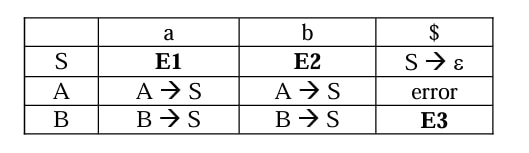
For the grammar below, a partial LL(1) parsing table is also presented along…

2012

For the grammar below, a partial LL(1) parsing table is also presented along with the grammar. Entries that need to be filled are indicated as E1, E2, and E3. \(\varepsilon\) is the empty string, $ indicates end of input, and, | separates alternate right hand sides of productions.

\(\to\) a A b B | b A a B | \(\varepsilon\)

\(\to\) S

\(\to\) S

The FIRST and FOLLOW sets for the non-terminals A and B are

  1. A.

    FIRST(A) = {a, b, \(\varepsilon\)} = FIRST(B)

    FOLLOW(A) = {a, b}

    FOLLOW(B) = {a, b, $}

  2. B.

    FIRST(A) = {a, b, $}

    FIRST(B) = {a, b, \(\varepsilon\)} F

    OLLOW(A) = {a, b}

    FOLLOW(B) = {$}

  3. C.

    FIRST(A) = {a, b, \(\varepsilon\)} = FIRST(B)

    FOLLOW(A) = {a, b}

    FOLLOW(B) = \(\phi\)

  4. D.

    FIRST(A) = {a, b} = FIRST(B)

    FOLLOW(A) = {a, b}

    FOLLOW(B) = {a, b}

Attempted by 118 students.

Show answer & explanation

Correct answer: A

Solution:

Compute FIRST sets.

  1. FIRST(S) = {a, b, ε} because S → a A b B, S → b A a B, and S → ε.

  2. FIRST(B) = FIRST(S) = {a, b, ε} because B → S.

  3. FIRST(A): from A → S B include FIRST(S) \{ε} = {a, b}. Since S can produce ε, also include FIRST(B) which contains ε, so FIRST(A) = {a, b, ε}.

Compute FOLLOW sets.

  1. Start: FOLLOW(S) contains $ because S is the start symbol.

  2. From S → a A b B and S → b A a B, A is followed by b or a, so add {a, b} to FOLLOW(A). Thus FOLLOW(A) ⊇ {a, b}.

  3. From A → S B: for S before B, add FIRST(B) \{ε} = {a, b} to FOLLOW(S). Because FIRST(B) contains ε, also add FOLLOW(A) to FOLLOW(S).

  4. From B → S: S is at the end, so add FOLLOW(B) to FOLLOW(S).

  5. From S → ... B (B at the end of S-productions), add FOLLOW(S) to FOLLOW(B).

Solve these inclusions:

  • FOLLOW(A) = {a, b} (no other symbols follow A in the grammar).

  • FOLLOW(S) must include $ and {a, b} (from the relations), so FOLLOW(S) = {a, b, $}.

  • FOLLOW(B) includes FOLLOW(S) and FOLLOW(A), giving FOLLOW(B) = {a, b, $}.

Final answer:

  • FIRST(A) = {a, b, ε} = FIRST(B)

  • FOLLOW(A) = {a, b}

  • FOLLOW(B) = {a, b, $}

A video solution is available for this question — log in and enroll to watch it.

Explore the full course: Gate Guidance By Sanchit Sir