Consider the following grammar where 𝑆 is the start symbol, and 𝑎 and 𝑏 are…
2026
Consider the following grammar where 𝑆 is the start symbol, and 𝑎 and 𝑏 are terminal symbols.
𝑆 → 𝑎𝑆𝑏𝑆 ∣ 𝑏𝑆 ∣ ϵ
Which of the following statements is/are true?
Answer: A. (A) The grammar is ambiguous; B. (B) The string 𝑎𝑏𝑏 has two distinct derivations in this grammar; C. (C) The string 𝑎𝑏𝑎𝑏 has only one rightmost derivation — SOLUTION: OPTION A) TRUE. The grammar is ambiguous. A grammar is ambiguous if and only if there exists at least one string in L(G) for which the grammar…
- A.
(A) The grammar is ambiguous
- B.
(B) The string 𝑎𝑏𝑏 has two distinct derivations in this grammar
- C.
(C) The string 𝑎𝑏𝑎𝑏 has only one rightmost derivation
- D.
(D) The language generated by the grammar is undecidable
Attempted by 56 students.
Show answer & explanation
Correct answer: A, B, C
SOLUTION:
OPTION A) TRUE. The grammar is ambiguous.
A grammar is ambiguous if and only if there exists at least one string in L(G) for which the grammar produces more than one parse tree.
String abb ∈ L(G) and G produces more than one parse tree for abb:
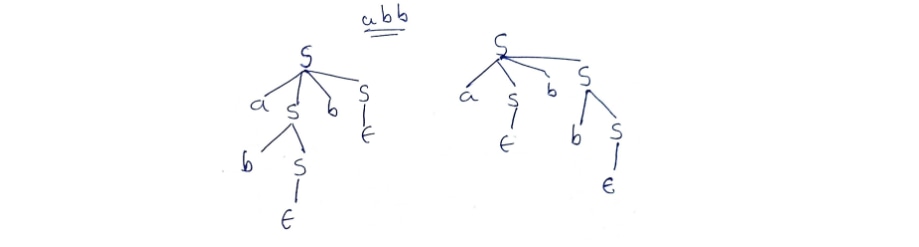
OPTION B) TRUE. The string abb has two distinct derivations in this grammar.
1st derivation:
S ⇒ aSbS
⇒ abS
⇒ abbS
⇒ abb
2nd derivation:
S ⇒ aSbS
⇒ abSbS
⇒ abbS
⇒ abb
Note that the question is not asking for rightmost (or leftmost) derivations. It is just asking about derivations. There are more than 2 derivations of the string abb, but the question is asking for the existence of at least two derivations.
OPTION C) TRUE. The string abab has only one rightmost derivation.
S ⇒rmd aSbS
⇒rmd aSbaSbS
⇒rmd aSbaSb
⇒rmd aSbab
⇒rmd abab
At each step, the next terminal forces a unique production choice, so no alternative rightmost derivation exists.
This fact can also be seen using the parse tree. There is only 1 parse tree that yields the string abab. Therefore, only 1 rightmost derivation exists. For any CFG, the number of rightmost derivations is the same as the number of parse trees for a given string.
OPTION D) False. The language generated by the grammar is undecidable.
This is incorrect. The given grammar is a context-free grammar (CFG), and every language generated by a CFG is a context-free language. Membership testing for context-free languages is decidable.
Therefore, the language generated by the grammar is decidable, not undecidable.