For real let fx=x then,
For real x, let fx=x3+5x+1, then,
- A.
f is one-to-one but not onto R
- B.
f is onto but not one-to-one R
- C.
f is one-to-one and onto R
- D.
f is neither one-to-one not onto R
Attempted by 77 students.
Show answer & explanation
Correct answer: C
Consider f(x) = x^3 + 5x + 1.
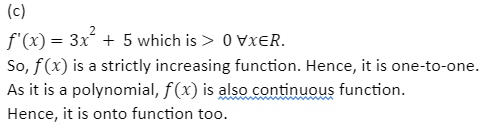
Injective (one-to-one): f'(x) = 3x^2 + 5, which is greater than 0 for all real x. Therefore f is strictly increasing on R and hence one-to-one.
Surjective (onto R): As x → ∞, f(x) → ∞ and as x → −∞, f(x) → −∞. Because f is continuous (being a polynomial) and its range extends to both ±∞, it attains every real value, so it is onto R.
Therefore f is both one-to-one and onto R (a bijection).