What is output of Y in the given circuit? I. BC+AC' II. (A+C)(B+C')
2021
What is output of Y in the given circuit? I. BC+AC' II. (A+C)(B+C')
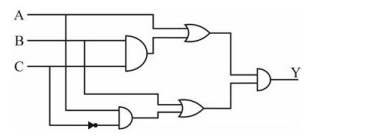
Answer: C. Both I and II — A combinational circuit's Boolean output is found by tracing signals gate by gate from the inputs to the final gate and writing the algebraic expression as…
- A.
Only I
- B.
Only II
- C.
Both I and II
- D.
Neither I nor II
Attempted by 359 students.
Show answer & explanation
Correct answer: C
A combinational circuit's Boolean output is found by tracing signals gate by gate from the inputs to the final gate and writing the algebraic expression as you go; that raw expression can then be reduced using Boolean laws such as idempotence (B·B=B), the complement law (C·C′=0), and the consensus theorem, which drops a product term that is already covered by two other terms. Because the same Boolean function can be written in more than one equivalent form — a sum-of-products (SOP) or a factored product-of-sums (POS) — two differently shaped expressions can both correctly describe one and the same circuit.
Tracing this circuit's two gate paths separately, then reducing algebraically:
Upper path: an AND gate combines B and C, giving BC; an OR gate then combines A with this, giving A+BC.
Lower path: C is first inverted to C′; an AND gate combines A and C′, giving AC′; an OR gate then combines B with this, giving B+AC′.
Final AND gate: Y=(A+BC)(B+AC′).
Expanding: Y=AB+AC′+BBC+ABCC′. Since BB=B and CC′=0, this reduces to Y=AB+AC′+BC.
AB is redundant by the consensus theorem: AB=AB(C+C′)=ABC+ABC′, and ABC is already covered by BC while ABC′ is already covered by AC′. Dropping AB gives Y=BC+AC′ — exactly statement I.
Refactoring BC+AC′ by grouping gives (A+C)(B+C′); expanding this back confirms it: (A+C)(B+C′)=AB+AC′+BC+CC′=AB+AC′+BC (since CC′=0), which reduces to the same BC+AC′ by dropping the redundant AB — exactly statement II.
As a check, substitute A=1, B=0, C=1 directly into the circuit: the upper path gives A+BC=1+0=1, the lower path gives B+AC′=0+(1·0)=0, so Y=1·0=0. Statement I gives BC+AC′=0+0=0, and statement II gives (A+C)(B+C′)=(1+1)(0+0)=1·0=0 — both match the circuit's direct evaluation for this input.
Since the circuit's output algebraically equals both BC+AC′ (statement I) and (A+C)(B+C′) (statement II) — two equivalent forms of one identical function — both statements correctly describe Y.