The question given below contains three elements. These elements may or may…
2024
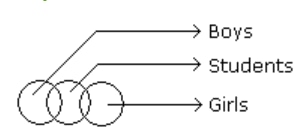
The question given below contains three elements. These elements may or may not have some inter linkage. Each group of elements may fit into one of the diagrams given below. You have to indicate the diagram that correctly fits the given group of elements. Which of the following diagrams indicates the best relation between Boys, Girls and Students?
Attempted by 1 students.
Show answer & explanation
Concept: In a three-set classification diagram, translate each pairwise real-world relationship into a shape rule -- two circles that never touch mean the two groups share no common member (mutually exclusive); two circles that partially overlap mean only some members are common to both; and one circle drawn fully inside another means every member of the inner group is also a member of the outer group. The correct diagram must satisfy all three pairwise relationships among the given terms at once.
Application: Apply this to Boys, Students and Girls.
Boys and Girls: no person can be classified as both a boy and a girl at the same time, so these two groups are mutually exclusive -- their circles must not overlap each other at all.
Boys and Students: only some boys are students (many boys are too young for school or are not currently enrolled), so Boys and Students share only a partial overlap, not full containment.
Girls and Students: by the same reasoning, only some girls are students, so Girls and Students also share only a partial overlap, not full containment.
So the diagram needs three circles where the Students circle overlaps each of the Boys and Girls circles, while the Boys and Girls circles do not overlap each other at all -- a chain arrangement, not a full nesting and not a three-way shared overlap.
Cross-check: testing the other possible layouts against these same three relationships rules each of them out:
Three circles drawn one entirely inside the next (a fully nested arrangement) would make each group a total subset of the next, which is wrong here because Boys and Girls are never one inside the other.
A circle containing two circles that overlap each other would mean those two inner groups share members with each other, incorrectly suggesting some people are counted as both Boys and Girls.
A circle containing one smaller circle, with a third circle sitting completely apart and untouched, would cut one of the three groups off from any relationship with the other two -- but every one of Boys, Students and Girls actually shares some members with at least one of the others.
Result: only the arrangement where two same-size circles each overlap a shared middle circle, without touching each other, satisfies all three relationships simultaneously -- Students overlapping both Boys and Girls, while Boys and Girls remain fully separate from each other. The source diagram below confirms this labelling directly (Boys and Girls each overlapping the shared Students circle, with no overlap between Boys and Girls).