Choose the conclusion that logically follows from the given statements.…
2024
Choose the conclusion that logically follows from the given statements.
Statements:
Some bottles are cups.
Some cups are pens.
Conclusions:
Some bottles are pens.
Some pens are bottles.
All the pens are cups.
All the cups are bottles.
- A.
Only (2) and (4)
- B.
Only (2)
- C.
Only (2) and (3)
- D.
None
Attempted by 1 students.
Show answer & explanation
Correct answer: D
When both premises of a syllogism are particular ("Some X are Y") statements, no valid conclusion can be drawn between their end terms. This follows from two classical syllogism rules: an "I" (particular affirmative) proposition never distributes either of its terms, so a middle term that is undistributed in both premises cannot validly link the end terms (the undistributed-middle fallacy); and a conclusion can never be universal ("All X are Y") when either premise is particular.
Statement 1 ("Some bottles are cups") and Statement 2 ("Some cups are pens") share the middle term cups; it is undistributed in both because each statement is a particular ("some") statement.
Because cups is undistributed in both statements, the members of cups overlapping with bottles need not be the same members overlapping with pens — so neither "Some bottles are pens" (1) nor its converse "Some pens are bottles" (2) is forced by the statements.
A universal conclusion ("All ... are ...") can never follow when either premise is particular; both given statements are particular, so "All the pens are cups" (3) and "All the cups are bottles" (4) are ruled out on this ground alone.
Since every one of the four listed conclusions fails one of these checks, none of them is logically guaranteed by the statements.
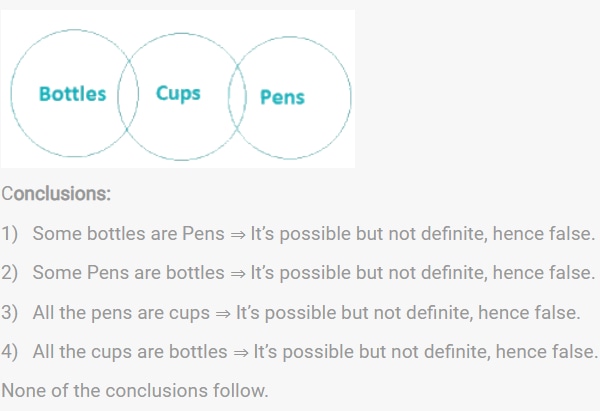
Cross-check with a concrete model: let bottles = {1,2}, cups = {2,3}, pens = {3,4}. This satisfies both statements (2 is a bottle and a cup; 3 is a cup and a pen), yet bottles and pens share no element, pens is not wholly inside cups, and cups is not wholly inside bottles — so all four conclusions are false in this valid model, confirming that none of them follow necessarily.
Hence, none of the four conclusions logically follows from the given statements.