Choose the conclusion that logically follows from the given statements.…
2023
Choose the conclusion that logically follows from the given statements.
Statements:
No phone is a book.
All the books are erasers.
Conclusions:
No phone is an eraser
No eraser is a phone
Some erasers are books
All the erasers are books
- A.
only 2 and 4
- B.
only 1 and 3
- C.
only 3 and 4
- D.
only 3
Attempted by 1 students.
Show answer & explanation
Correct answer: D
Concept: A syllogistic conclusion is valid only if it holds true in every possible diagram consistent with the given statements, not merely in one arrangement that looks plausible. Two rules govern this pair of statements: a universal affirmative ‘All A are B’ converts validly only to ‘Some B are A’ (never to ‘All B are A’), and when a middle term links a universal affirmative to a separate universal negative, no relation between the two end terms is forced unless containment demands it.
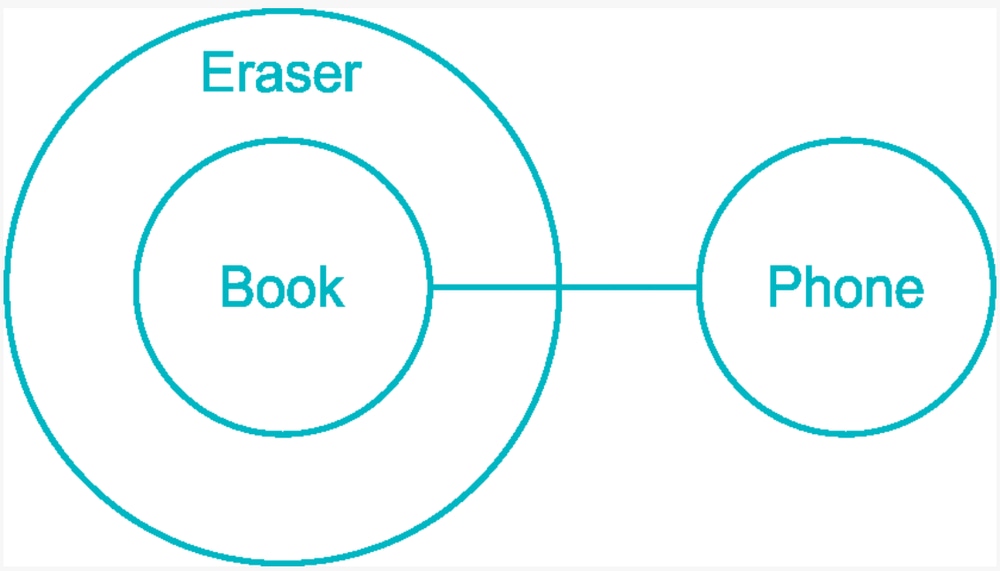
Application: The middle term here is ‘Book’. ‘No phone is a book’ keeps the Phone circle entirely outside the Book circle. ‘All the books are erasers’ keeps the Book circle entirely inside the Eraser circle. Checking each conclusion against this:
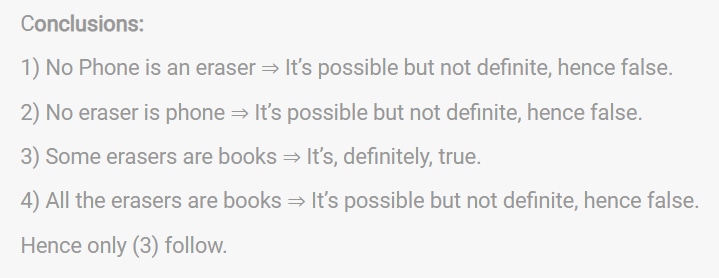
No phone is an eraser — the size and position of the Eraser circle relative to Phone is not fixed by either statement; Eraser could be drawn to reach into Phone's circle or to stay clear of it, so this is only possible, not definite.
No eraser is a phone — this states the same undetermined relation the other way round, so it is equally only possible, not definite.
Some erasers are books — since the entire Book circle lies inside the Eraser circle, and ‘Book’ is a non-empty class, the book region necessarily lies within the eraser region in every valid diagram; this is the valid conversion of ‘All the books are erasers’, so it holds for certain.
All the erasers are books — the containment only runs one way (Book inside Eraser); the Eraser circle is free to extend beyond the Book circle, so this is only possible, not definite.
Cross-check: The diagram below shows one valid arrangement — Eraser (outer circle) contains Book (inner circle), while Phone is drawn as a separate circle with no forced touching or overlap with Eraser. An equally valid second arrangement could instead let the Eraser circle spread out to overlap Phone. Because both arrangements satisfy the two statements yet disagree on the phone–eraser relationship, no conclusion linking phone and eraser can ever be definite — only the book–eraser conversion is forced in every arrangement.
Hence only conclusion 3, ‘Some erasers are books’, follows for certain — the correct option is ‘only 3’.