Two statements are given below, followed by two conclusions numbered (1) and…
2025
Two statements are given below, followed by two conclusions numbered (1) and (2). Assume the statements to be true even if they seem to be at variance with commonly known facts. Decide which of the conclusions logically follows from the given statements.
Statements:
All the actors are girls.
All the girls are beautiful.
Conclusions:
All the actors are beautiful.
Some girls are actors.
- A.
Only (1) conclusion follows
- B.
Only (2) conclusion follows
- C.
Either (1) or (2) follows
- D.
Neither (1) nor (2) follows
- E.
Both (1) and (2) follow
Attempted by 1 students.
Show answer & explanation
Correct answer: E
Concept
A syllogism is judged only by what the statements force, using class containment: "All P are Q" means the entire P-circle lies inside the Q-circle. In the classical convention that these reasoning papers use, every class named in a statement is taken to be non-empty.
Two rules follow from that. (i) Containment is transitive: if P lies inside Q and Q lies inside R, then P lies inside R. (ii) A universal statement yields its particular converse: from "All P are Q", since there is at least one P and every P is a Q, it follows that "Some Q are P".
Application
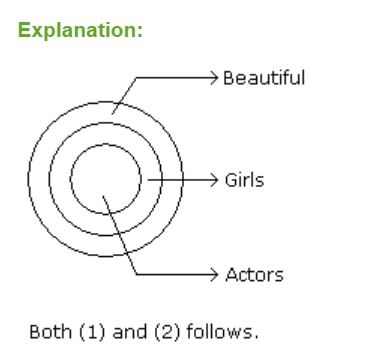
Statement 1, "All the actors are girls", places the whole Actors circle inside the Girls circle.
Statement 2, "All the girls are beautiful", places the whole Girls circle inside the Beautiful circle.
Both statements therefore fit one single diagram: three nested circles, Actors inside Girls inside Beautiful.
Conclusion (1), "All the actors are beautiful": by rule (i), containment is transitive — Actors inside Girls inside Beautiful puts Actors wholly inside Beautiful. It follows.
Conclusion (2), "Some girls are actors": by rule (ii), the Actors class is non-empty and sits inside Girls, so at least one girl is an actor — this is the particular converse of statement 1. It follows.
Cross-check and contrast
No counter-diagram exists. Both statements are universal, so the nesting is forced; there is no second arrangement in which either conclusion fails.
"Either ... or" would need a complementary pair — one of the two guaranteed, but which one left undecided. Here nothing is left undecided, so that reading does not apply.
"Neither ... nor" would need the statements to force nothing at all, which contradicts the hard containment that "All ..." asserts.
A note on convention: under strict modern predicate logic, which permits an empty class, conclusion (2) would not follow. Competitive-exam syllogism — and the official key for this item — uses the classical convention with existential import, under which it does.
Result: Both (1) and (2) follow.