Statements: All the locks are keys. All the keys are bats. Some watches are…
2025
Statements:
All the locks are keys.
All the keys are bats.
Some watches are bats.
Conclusions:
Some bats are locks.
Some watches are keys.
All the keys are locks.
- A.
Only (1) and (2)
- B.
Only (1)
- C.
Only (2)
- D.
Only (1) and (3)
Attempted by 1 students.
Show answer & explanation
Correct answer: B
Concept: When two universal statements chain through a common middle term — “All A are B” and “All B are C” — the two end terms combine into another universal statement, “All A are C” (standard categorical-syllogism transitivity). A universal statement of this kind also carries the weaker particular claim beneath it (“Some A are C”), which can then be reversed by simple conversion into “Some C are A”. A particular statement (“Some P are Q”), by contrast, never combines with an unrelated universal statement to yield any conclusion about a third term that isn't explicitly connected to it.
Application:
All the locks are keys, and all the keys are bats, so every lock is a bat (a direct chain through the middle term). This universal also holds a particular claim beneath it — some locks are bats — which converts to “some bats are locks”. This is exactly conclusion (1), so it follows.
The statement “Some watches are bats” places watches only in the bat category; it never connects watches to the key category, because keys and watches share no direct or chained premise between them. So conclusion (2) — a watches-keys claim — is not forced by the statements.
“All the locks are keys” only states that the lock category sits inside the key category; it does not state the reverse. Without a separate premise establishing that direction, conclusion (3) — a claim in the opposite direction — is not forced either.
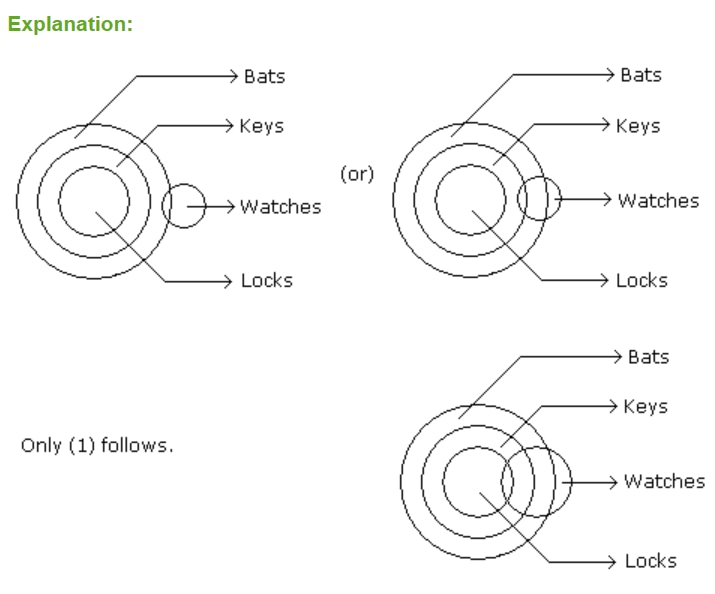
Cross-check: Draw locks as a circle fully inside keys, keys fully inside bats, and watches as a separate circle overlapping bats only. This diagram satisfies every statement, and in it the locks circle (being inside bats) always creates an overlap with bats, confirming conclusion (1) in every valid version of the diagram. But watches can be drawn overlapping bats in a region completely outside keys, and keys need not be drawn inside locks — so conclusions (2) and (3) can both be false in a valid diagram, meaning they are not guaranteed.
Result: Only conclusion (1) is guaranteed by the statements, so “Only (1)” is the correct combination.