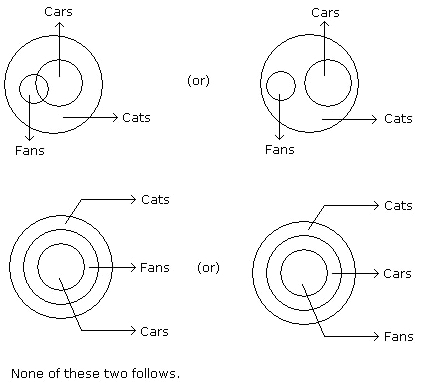
Statements: All cars are cats. All fans are cats. Conclusions: All cars are…
2025
Statements:
All cars are cats.
All fans are cats.
Conclusions:
All cars are fans.
Some fans are cars.
Answer: D. Neither (1) nor (2) follows — Concept: When two universal statements share a common predicate — “All X are Z” and “All Y are Z” — X and Y are each independently linked to Z, but nothing in…
- A.
Only (1) conclusion follows
- B.
Only (2) conclusion follows
- C.
Either (1) or (2) follows
- D.
Neither (1) nor (2) follows
Attempted by 1 students.
Show answer & explanation
Correct answer: D
Concept: When two universal statements share a common predicate — “All X are Z” and “All Y are Z” — X and Y are each independently linked to Z, but nothing in the statements fixes any relationship between X and Y themselves. A conclusion connecting X and Y can be treated as following only if it is forced to be true in every arrangement of X and Y that is consistent with both statements; if even one such arrangement makes it false, the conclusion does not follow.
Application: Here, Cars are a subset of Cats and Fans are a subset of Cats — both statements are universal and share the same predicate, Cats. Testing the two conclusions means checking every arrangement of Cars and Fans consistent with both statements: they could be two completely separate groups inside Cats, they could overlap partially, or one could sit entirely inside the other. In the fully separate arrangement, no car is a fan and no fan is a car, so both proposed conclusions fail together — and since that arrangement is fully consistent with the given statements, neither conclusion is forced to be true in every case.
Comparing the other options:
Only conclusion (1) follows — this treats “all cars are fans” as certain, but the fully separate arrangement above is equally consistent with the statements and defeats it.
Only conclusion (2) follows — this treats “some fans are cars” as certain, but the same fully separate arrangement defeats it too, since it requires no overlap at all between cars and fans.
Either (1) or (2) follows — this either-or reading only applies when the two conclusions are a complementary pair that together must cover every possibility; the fully separate arrangement makes both false at once, so they are not such a pair.
Cross-check: Because the fully separate arrangement is never ruled out by the statements, and the two conclusions can fail simultaneously rather than forming a complementary either-or pair, no relationship between cars and fans can be pinned down from what is given.
Result: Neither conclusion (1) nor conclusion (2) follows from the statements.