Statements: All the books are pencils. No pencil is eraser. Conclusions: (1)…
2025
Statements:
All the books are pencils.
No pencil is eraser.
Conclusions:
(1) All the pencils are books.
(2) Some erasers are books.
(3) No book is eraser.
(4) Some books are erasers.
Answer: A. Only (3) — In syllogisms, a universal affirmative statement of the form "All A are B" means the entire set A sits inside set B, but it does not establish the reverse…
- A.
Only (3)
- B.
Only (1) and (3)
- C.
Only (1) and (2)
- D.
Only (2) and (3)
Attempted by 1 students.
Show answer & explanation
Correct answer: A
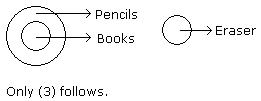
In syllogisms, a universal affirmative statement of the form "All A are B" means the entire set A sits inside set B, but it does not establish the reverse relation "All B are A". A universal negative statement of the form "No A is B" means the sets A and B share zero common members (they are disjoint). When two premises share a common middle term, they can be chained through that term to test what necessarily follows.
Applying this to the two statements:
All the books are pencils → the book set lies completely inside the pencil set.
No pencil is eraser → the pencil set has no overlap at all with the eraser set.
Chaining through the common term "pencil": since books sit entirely inside pencils, and pencils share no members with erasers, books cannot share any members with erasers either.
Checking each conclusion against this chain:
Conclusion | Verdict | Reason |
|---|---|---|
(1) All the pencils are books | Does not follow | Reverses the direction of the first statement; a subset relation does not imply its converse. |
(2) Some erasers are books | Does not follow | Would require an overlap between erasers and books, which the chain above rules out entirely. |
(3) No book is eraser | Follows | Exactly what the chain through "pencil" establishes. |
(4) Some books are erasers | Does not follow | Directly contradicts the zero-overlap relationship established above. |
So only conclusion (3) follows validly from the two statements — the correct answer is Only (3).