Each question has a set of four statements. Each statement has three segments.…
2025
Each question has a set of four statements. Each statement has three segments. Choose the alternative in which the third segment can be logically deduced using both the preceding two together, but not from either one alone.
A. No clerks cry; Some who cry are phoenixes; Some phoenixes are not clerks.
B. All dreams are colourful; Some dreams are not scary; Some that are scary are not colourful.
C. Jesters indulge in lying; Those who lie are crucified; Some who are crucified are not jesters.
D. Some modern artists are moody; All modern artists are gourmands; Some gourmands are moody.
- A.
D only
- B.
A and B
- C.
C only
- D.
A and D
Attempted by 2 students.
Show answer & explanation
Correct answer: D
CONCEPT: To test whether a stated third segment necessarily follows from two given premises sharing a common term, combine the premises using the standard categorical rules: (1) two universal-negative premises fix nothing; (2) a universal-negative premise together with a particular premise on the same middle term forces the individuals common to both into the class outside the negated group, yielding a valid particular-negative conclusion; (3) two universal-affirmative premises linked by a common middle term force only a further universal (or, under existential import, a particular-affirmative) conclusion between the outer terms — never a particular-negative one; and (4) a universal premise paired with a particular-negative premise about the same subject does not, by itself, fix any relationship for a term appearing in only one of the two premises. A third segment is validly deducible only when it is forced by both premises acting together and cannot already be forced by either premise alone.
Application:
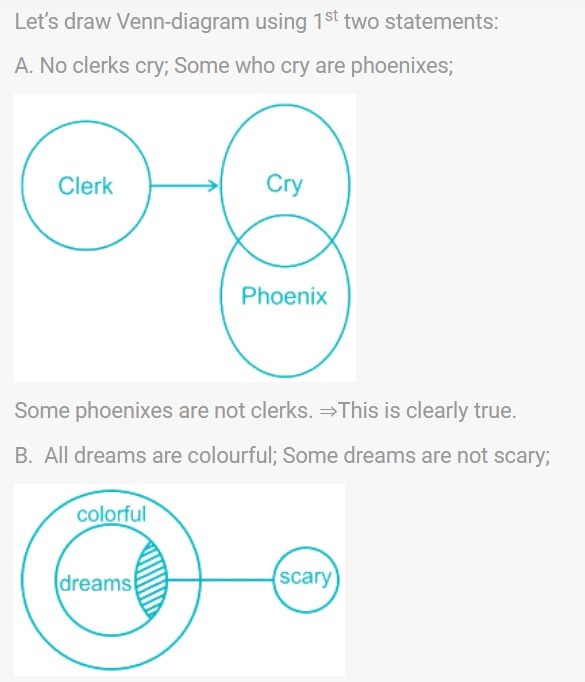
Statement A: 'No clerks cry' places the Clerk group entirely outside the Cry group. 'Some who cry are phoenixes' places an overlapping group between Cry and Phoenix. Every individual in that Cry–Phoenix overlap is, by the first premise, excluded from Clerk — so those individuals are phoenixes that are not clerks. This is rule (2) above: the third segment is forced, and it needs both premises (the first premise alone says nothing about phoenixes; the second alone says nothing about clerks).
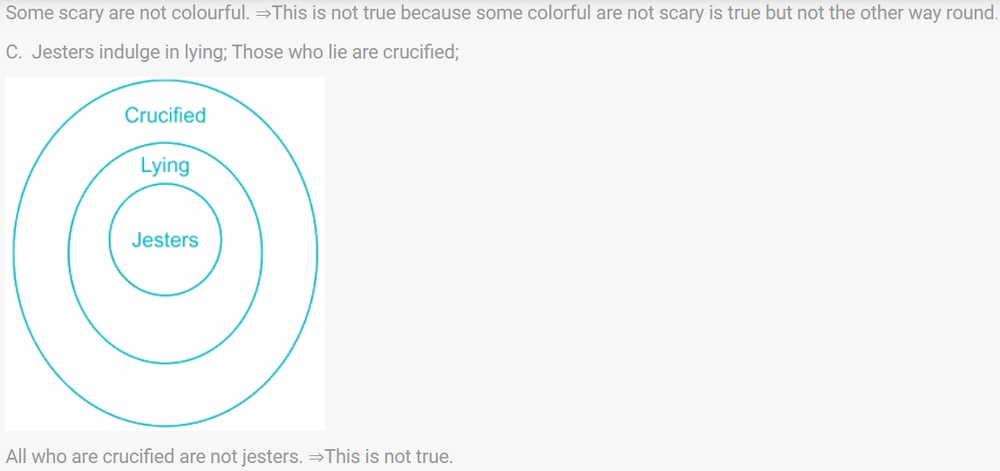
Statement B: 'All dreams are colourful' and 'Some dreams are not scary' share the subject Dream but say nothing that links Scary to Colourful — this is rule (4). A model in which every scary thing happens to be one of the dreams that IS colourful (with only the non-scary dreams being the 'some not scary') satisfies both premises while making 'Some that are scary are not colourful' false. So this third segment is not forced.
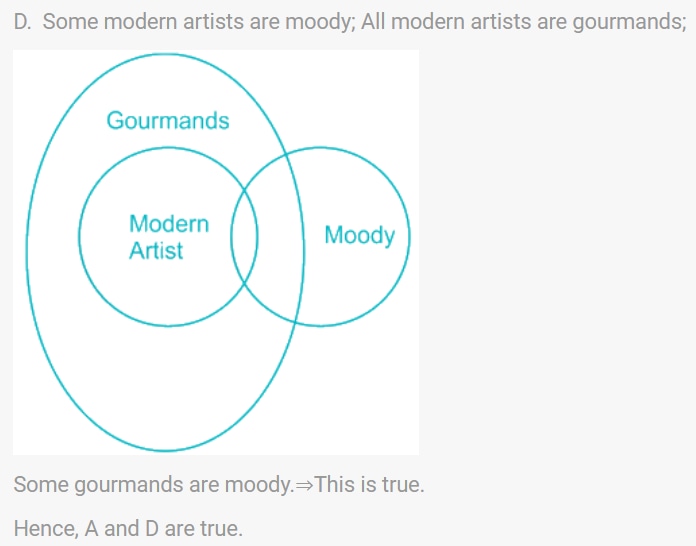
Statement C: 'Jesters indulge in lying' and 'Those who lie are crucified' are both universal-affirmative, linking Jester → Lie → Crucified. By rule (3), transitivity only forces 'All jesters are crucified,' never a particular-negative claim like 'Some who are crucified are not jesters' — a model where Crucified, Lie, and Jester happen to coincide exactly satisfies both premises while making this third segment false.
Statement D: 'Some modern artists are moody' gives an overlap between Modern Artist and Moody. 'All modern artists are gourmands' places every modern artist inside Gourmand. The individuals in the Modern-Artist–Moody overlap are therefore also Gourmands (by the second premise) — so those individuals are gourmands that are moody. This is rule (2)'s affirmative counterpart: the conclusion is forced jointly, and neither premise alone mentions both Gourmand and Moody together.
CROSS-CHECK: The accompanying Venn diagrams confirm this: Clerk is drawn disjoint from Cry while Phoenix overlaps Cry (statement A); Modern Artist is drawn as a subset of Gourmand while also overlapping Moody (statement D). No diagram forces the scary-colour link in B or the crucified-jester exclusion in C.
Only statements A and D pass the test, so the third segment is validly deducible using both preceding segments together — but not from either alone — precisely for A and D.