Statements: Some envelopes are gums. Some gums are seals. Some seals are…
2024
Statements:
Some envelopes are gums.
Some gums are seals.
Some seals are adhesives.
Conclusions:
Some envelopes are seals.
Some gums are adhesives.
Some adhesives are seals.
Some adhesives are gums.
- A.
Only (3)
- B.
Only (1)
- C.
Only (2)
- D.
Only (4)
Attempted by 3 students.
Show answer & explanation
Correct answer: A
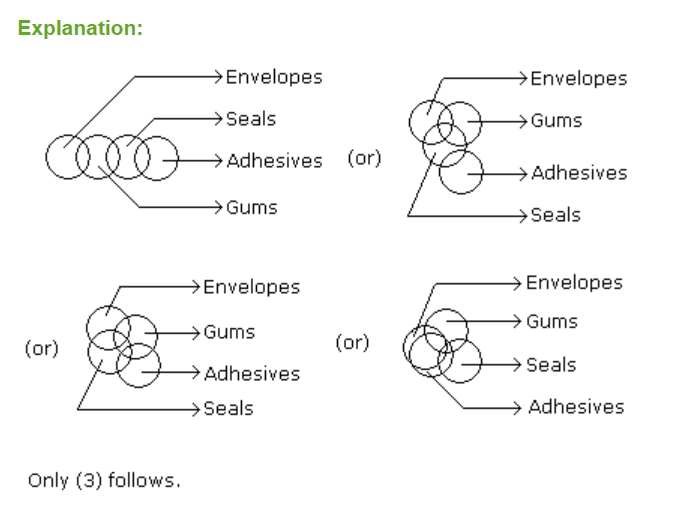
Concept: In syllogisms, a particular ('Some A are B') statement can be converted on its own into 'Some B are A' - this simple conversion is always valid because 'Some A are B' and 'Some B are A' describe the exact same overlap between A and B, just named in the other order. But when two 'Some' premises share a common middle term, that middle term is distributed in neither premise, so no conclusion linking the two outer (extreme) terms is ever validly forced - a chain of two 'Some' statements never guarantees a further 'Some' relationship between their end terms.
Checking each conclusion:
Conclusion | Basis | Verdict |
|---|---|---|
Some envelopes are seals | Needs statements 1+2 chained through 'gums' (undistributed in both) | Does not follow |
Some gums are adhesives | Needs statements 2+3 chained through 'seals' (undistributed in both) | Does not follow |
Some adhesives are seals | Direct conversion of statement 3 alone | Follows |
Some adhesives are gums | Needs the same unguaranteed chain as above, reversed | Does not follow |
Cross-check: a Venn diagram consistent with all three statements can place the gums-seals overlap and the seals-adhesives overlap on different portions of the seals circle, and the envelopes-gums overlap on yet another portion of the gums circle. In such a diagram envelopes and seals need not touch, and adhesives and gums need not touch - so conclusions 1, 2, and 4 are not necessarily true. Conclusion 3 is guaranteed regardless of the diagram, since it just restates the same population from statement 3 the other way round.
Result: only conclusion 3 necessarily follows.