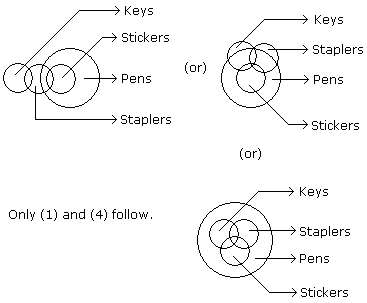
Statements: Some keys are staplers. Some staplers are stickers. All the…
2025
Statements:
Some keys are staplers.
Some staplers are stickers.
All the stickers are pens.
Conclusions:
(1) Some pens are staplers.
(2) Some stickers are keys.
(3) No sticker is key.
(4) Some staplers are keys.
Answer: D. Only (1) and (4) and either (2) or (3) — In syllogism, a definite conclusion can only be justified by one of four moves: (a) direct conversion — "Some A are B" always yields "Some B are A"; (b)…
- A.
Only (1) and (2)
- B.
Only (2) and (4)
- C.
Only (2) and (3)
- D.
Only (1) and (4) and either (2) or (3)
Attempted by 4 students.
Show answer & explanation
Correct answer: D
In syllogism, a definite conclusion can only be justified by one of four moves: (a) direct conversion — "Some A are B" always yields "Some B are A"; (b) chaining a particular ("some") statement with a universal ("all") statement that shares a middle term — "Some A are B" + "All B are C" gives "Some A are C" (and its converse); (c) two particular statements sharing only a middle term never justify any conclusion about their other two end terms — the classic fallacy of two particular premises; and (d) when neither a "some X are Y" nor a "no X is Y" conclusion can be pinned down individually, but every diagram consistent with the statements forces exactly one of the two to hold, they form a valid "either…or" pair.
Applying this to the given statements:
Conclusion (4), "Some staplers are keys", is the direct converse of Statement 1, "Some keys are staplers" — by rule (a) this follows immediately, with no further combination needed.
Conclusion (1), "Some pens are staplers", comes from chaining Statement 2, "Some staplers are stickers", with Statement 3, "All the stickers are pens": the shared middle term "stickers" lets rule (b) combine them into "Some staplers are pens", whose converse is exactly conclusion (1).
Conclusions (2), "Some stickers are keys", and (3), "No sticker is key", both try to relate stickers to keys directly, but the only path connecting the two runs through "staplers" via Statement 1 and Statement 2 — both particular statements sharing that middle term. By rule (c), two particular premises never justify a conclusion about the end terms, so neither (2) nor (3) follows on its own.
Because neither the "some" nor the "no" relationship between stickers and keys can be ruled out by the statements, every diagram consistent with them forces exactly one of the two to hold — by rule (d) this makes "either (2) or (3)" the valid reading of that pair.
Checking this against the options: the definite conclusions are (1) and (4), together with the either/or pairing of (2) and (3). Dropping (1) or (4) would discard a validly derived conclusion, and asserting (2) or (3) alone — or both together as separate certainties — contradicts the either/or requirement, so only the combination of exactly these three elements is consistent with the syllogism rules.