Statements: Some rats are cats. Some cats are dogs. No dog is cow.…
2023
Statements: Some rats are cats. Some cats are dogs. No dog is cow. Conclusions: (1) No cow is cat. (2) No dog is rat. (3) Some cats are rats.
Answer: A. Only (3) — ConceptA syllogism conclusion is 'definite' only if it holds in EVERY Venn diagram consistent with the given statements — if even one valid diagram breaks it,…
- A.
Only (3)
- B.
Only (1) and (2)
- C.
Only (1) and (3)
- D.
Only (2) and (3)
Attempted by 3 students.
Show answer & explanation
Correct answer: A
Concept
A syllogism conclusion is 'definite' only if it holds in EVERY Venn diagram consistent with the given statements — if even one valid diagram breaks it, the conclusion is rejected. A useful shortcut is the conversion rule: a particular-affirmative statement ('Some A are B') always converts to 'Some B are A', since 'some' merely asserts a non-empty overlap, which is symmetric.
Application
Statement (1), 'Some rats are cats', converts directly to 'Some cats are rats' — this is exactly Conclusion (3), so it is definite on its own, independent of the other two statements. Statement (2) ('Some cats are dogs') and Statement (3) ('No dog is cow') fix only the cat–dog overlap and the dog–cow boundary; neither statement constrains how the cow group sits relative to the cat group, or how the rat-subset of cats relates to the dog-subset of cats. So Conclusion (1) 'No cow is cat' and Conclusion (2) 'No dog is rat' are not forced by the given statements.
Cross-check
A valid diagram can place the cow region overlapping the part of the cat region that lies outside the dog overlap (cows partially inside cats, never touching dogs) — this satisfies all three statements yet makes Conclusion (1) false, so (1) does not follow.
A valid diagram can also let the rat-subset of cats and the dog-subset of cats overlap each other, or stay fully apart — both arrangements satisfy all three statements, but the first makes Conclusion (2) false while the second makes it true; since it is not true in every valid diagram, Conclusion (2) does not follow.
Conclusion (3), by contrast, is the direct converse of Statement (1) and holds in every diagram consistent with the statements, with no exception.
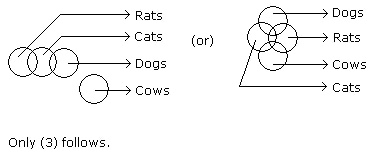
Hence only Conclusion (3) follows: Only (3).