DIRECTIONS: Krishnapuram's town council has exactly three members: Arjun,…
2024
DIRECTIONS: Krishnapuram's town council has exactly three members: Arjun, Karn, and Bhim. During one week, the council members vote on exactly three bills: a recreation bill, a school bill, and a tax bill. Each council member votes either for or against each bill. The following is known:
Each member of the council votes for at least one of the bills and against at least one of the bills.
Exactly two members of the council vote for the recreation bill.
Exactly one member of the council votes for the school bill.
Exactly one member of the council votes for the tax bill.
Arjun votes for the recreation bill and against the school bill.
Karn votes against the recreation bill.
Bhim votes against the tax bill.
If Karn votes for the tax bill, then which one of the following statements could be true?
Answer: A. Arjun and Karn each vote for exactly one bill. — Concept For a group whose members cast For/Against votes on several items under numeric quotas ("exactly N vote For") plus a rule that everyone must have at…
- A.
Arjun and Karn each vote for exactly one bill.
- B.
Karn and Bhim each vote for exactly one bill.
- C.
Arjun votes for exactly two bills.
- D.
Karn votes for the recreation bill.
Show answer & explanation
Correct answer: A
Concept
For a group whose members cast For/Against votes on several items under numeric quotas ("exactly N vote For") plus a rule that everyone must have at least one For and at least one Against vote, each item's quota can force a member's vote once enough clues are fixed, while a leftover choice among the remaining members can create more than one valid, fully consistent outcome. A "could be true" question asks which candidate statement holds in at least one such valid outcome — not necessarily every one.
Working
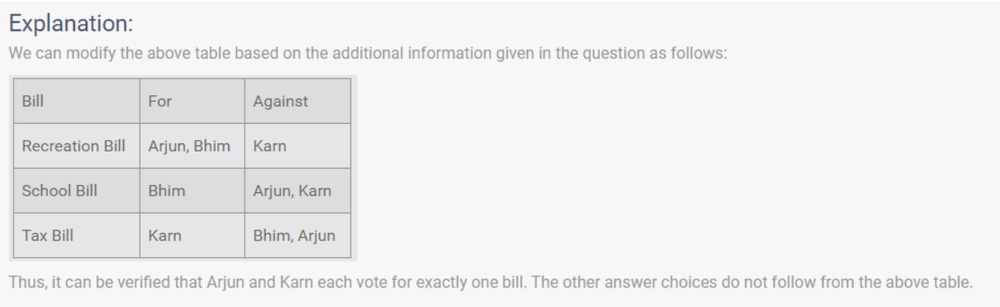
Tax bill: exactly one member votes For. Bhim is already against the tax bill (given), and this question's own condition makes Karn vote For the tax bill — so the tax bill's one permitted For vote is already used by Karn, meaning Arjun must be against the tax bill.
Recreation bill: exactly two members vote For. Arjun is For (given) and Karn is Against (given), so the second For vote must belong to Bhim.
School bill: exactly one member votes For. Arjun is Against the school bill (given), so the lone For vote belongs to either Karn or Bhim — the setup does not fix which, so both assignments must be checked against the "at least one For, at least one Against" rule for every member.
Checking both branches: if Karn takes the school bill's For vote, Karn ends with two For votes (tax, school) and Bhim ends with one (recreation); every member still has at least one For and one Against vote, so this branch is valid. If Bhim takes the school bill's For vote instead, Bhim ends with two For votes (recreation, school) and Karn ends with just one (tax); this branch is valid too. So the setup allows two different fully consistent voting records.
Tallying each member's total For votes across the two valid records: Arjun always ends at exactly one For vote (recreation only) in both. Karn ends at two For votes in the first record and exactly one in the second. Bhim ends at one For vote in the first record and two in the second.
Why the other statements fail
Since Arjun always ends at exactly one For vote in every valid record, a statement claiming Arjun votes for two bills can never be true.
Karn's For-vote total only ever varies between one and two across the two records — whichever of Karn or Bhim takes the school bill's For vote ends up at two, so a statement claiming both Karn and Bhim land at exactly one For vote each can never be true.
The setup already fixes Karn against the recreation bill, so a statement claiming Karn votes for the recreation bill is ruled out immediately, independent of the school-bill branch.
The record where Bhim, rather than Karn, takes the school bill's lone For vote leaves Arjun and Karn each at exactly one For vote — a genuinely achievable outcome, which is exactly the statement that could be true.
Answer
The statement that could be true is: Arjun and Karn each vote for exactly one bill.
Reference table (as originally worked out)