Eight colleagues H, I, J, K, L, M, N, and O are sitting surrounding an octagon…
2023
Eight colleagues H, I, J, K, L, M, N, and O are sitting surrounding an octagon table facing each other at different corners of the table. H is the second left to K. I is the neighbor of M and N. O is second left of N. L is between J and H. J is immediate to M.Who is the third person left to J?
- A.
N
- B.
O
- C.
I
- D.
H
Attempted by 1 students.
Show answer & explanation
Correct answer: A
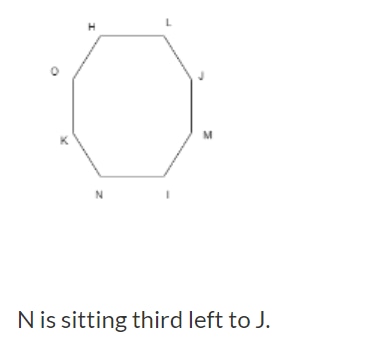
Concept: When all persons in a circular or polygonal seating arrangement face the centre of the table, moving in the "left" direction from any person corresponds to the clockwise direction as viewed from above. Every clue of the form "X is nth left/right of Y" or "X is the neighbour of Y" is really a positional equation on seat numbers taken modulo the total number of seats. The puzzle is solved by fixing one person's seat as a reference, translating every clue into such an equation, and finding the single arrangement of all persons that satisfies every equation at once.
Fix J's seat as position 0 (the reference point). Number the 8 seats 0-7 running clockwise, and since everyone faces the centre, "left" means increasing position number (clockwise).
"L is between J and H" makes L adjacent to both J and H, so J and H sit on the two sides of L. Checking the two possible placements of L relative to J shows only L at position 7 (with H at position 6) is consistent with the rest of the clues; the other placement later forces H's own clue onto J's seat, which is a contradiction.
"J is immediate to M" places M next to J. With position 7 already taken by L, the only free seat next to J is position 1, so M sits at position 1.
"I is the neighbour of M and N" means M and N are I's two neighbours. With M at position 1, checking both neighbour orders shows I must sit at position 2 (the other order collides with J's seat), which places N at position 3.
The two remaining seats, 4 and 5, go to K and O. "H is second left of K" gives position(K) = position(H) - 2 = 6 - 2 = 4, so K takes position 4.
"O is second left of N" gives position(O) = position(N) + 2 = 3 + 2 = 5, so O takes the last free seat, position 5.
The complete clockwise seating is now fixed. The third person to the left of J is three seats clockwise from J's seat: 0 + 3 = 3, which is N's seat.
Final arrangement (clockwise from J):
Seat position | Person |
|---|---|
0 | J |
1 | M |
2 | I |
3 | N |
4 | K |
5 | O |
6 | H |
7 | L |
Cross-check against every clue:
H is second left of K: K is at seat 4; two seats left (clockwise) of seat 4 is seat 6, which is H. Holds.
I is the neighbour of M and N: I (seat 2) sits between M (seat 1) and N (seat 3). Holds.
O is second left of N: N is at seat 3; two seats left of seat 3 is seat 5, which is O. Holds.
L is between J and H: L (seat 7) sits between H (seat 6) and J (seat 0). Holds.
J is immediate to M: J (seat 0) and M (seat 1) are adjacent seats. Holds.
So the third person to the left of J is N.