Each of these questions is based on the information given below: 8 persons —…
2023
Each of these questions is based on the information given below: 8 persons — E, F, G, H, I, J, K and L — are seated around a square table, two on each side. There are 3 ladies who are not seated next to each other. J is between L and F. G is between I and F. H, a lady, is second to the left of J. F, a male, is seated opposite E, a lady. There is a lady between F and I. What is true about J and K?
- A.
J is male, K is female
- B.
J is female, K is male
- C.
Both are female
- D.
Both are male
Attempted by 1 students.
Show answer & explanation
Correct answer: D
Concept: In a square-table seating puzzle, people are placed around the perimeter (two seats per side) using two kinds of position clues — a 'between' clue chains three people into one fixed block, and an 'opposite' clue fixes a person on the parallel side directly across the table (the mirrored seat, not the seat rotated 180 degrees through the centre). Any attribute clue (such as 'the three ladies are not adjacent') is then used only as a consistency check on the seating already fixed by the position clues.
Application:
G is between I and F, and J is between L and F. Since F is common to both clues, they chain into one five-seat block: I – G – F – J – L (five consecutive seats).
The lone person seated between F and I in this chain is G — confirming G as the female described by that clue.
The remaining three people — E, H and K — occupy the three seats between L and I that are not yet part of the chain.
From J, the two directions around the table lead first to F (already fixed) or first to L (already fixed). "H is second to the left of J" must refer to whichever direction still has an unfixed second seat: going via F, the second seat is G — already a different, named person — so that direction is ruled out; going via L, the second seat is the first of the three remaining seats, which must therefore be H, placed immediately after L.
That leaves K and E for the last two of the three remaining seats, which — being the only two seats left — together form the one side of the table not yet accounted for (the other three sides, I–G's, F–J's and L–H's, are already fixed). "F is seated opposite E" confirms this pair sits on the side directly facing F and J's side, closing the loop back to I.
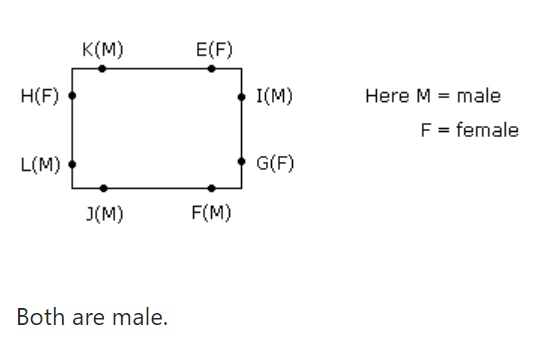
This reconstructs the complete seating, going around the table: K, E, I, G, F, J, L, H — two members on each side, exactly as the question requires.
Cross-check: The three seats fixed as female by steps 2, 4 and 5 are E, G and H. Checking neighbours in this seating — E sits between K and I, G between I and F, H between L and K — none of the three ladies sit next to one another, independently confirming the arrangement against the 'not seated next to each other' condition given in the question.
Result: J occupies the bottom-side seat next to F, and K occupies the top-side seat next to E — both of these seats fall outside the three seats fixed as female (E, G, H), so both J and K are male.
Person | Seated with (same side) | Gender |
|---|---|---|
K | E | Male |
E | K | Female |
I | G | Male |
G | I | Female |
F | J | Male |
J | F | Male |
L | H | Male |
H | L | Female |