Each of these questions are based on the information given below : 8 persons…
2023
Each of these questions are based on the information given below : 8 persons E, F, G, H, I, J, K and L are seated around a square table - two on each side. There are 3 ladies who are not seated next to each other. J is between L and F. G is between I and F. H, a lady member is second to the left of J. F, a male member is seated opposite to E, a lady member. There is a lady member between F and I.How many persons are seated between K and F ?
- A.
1
- B.
2
- C.
3
- D.
4
Attempted by 1 students.
Show answer & explanation
Correct answer: C
Concept: in a square-table seating puzzle with two seats per side (everyone facing the centre), a "between A and B" clue fixes three consecutive seats and a "second to the left/right of X" clue fixes a rotational direction; once the clues fix a long consecutive run of seats, any seat still open to two possible placements can usually be settled by testing each placement against a remaining clue (such as a count of ladies who must not sit together) and keeping only the placement that satisfies it.
Working out the arrangement:
J is between L and F, so three consecutive seats run L - J - F (in one direction round the table).
G is between I and F, so three consecutive seats run I - G - F; sharing the seat F with the previous clue links the two runs into one continuous stretch of five seats: I - G - F - J - L.
H, a lady, is second to the left of J: moving two seats to the left from J's seat lands on H, which places H immediately after L in the same direction, extending the stretch to six consecutive seats: I - G - F - J - L - H.
Only K and E remain for the last two seats, the ones that close the loop between H and I - in one of two possible orders (K next to H and E next to I, or E next to H and K next to I). E is a lady, and the puzzle states there are exactly three ladies (E, G and H) who never sit next to each other: seating E next to H would put two of those three ladies side by side, which the clue rules out, so K must be the one next to H, with E next to I. This closes the round as: K - E - I - G - F - J - L - H (and back to K).
This placement also satisfies "F, a male, is opposite E, a lady": F now sits on the seat directly facing E across the table, matching the clue.
The lady seated between F and I is G - this matches G (female) in the arrangement and independently confirms step 2.
Final check - the three ladies (E, G, H) for mutual adjacency in the completed arrangement: E's neighbours are K and I, G's neighbours are I and F, and H's neighbours are L and K - none of the three neighbours another, confirming the placement in step 4 and satisfying every clue given.
Seat (in order around the table) | Person | Gender |
|---|---|---|
1 | K | Male |
2 | E | Female |
3 | I | Male |
4 | G | Female |
5 | F | Male |
6 | J | Male |
7 | L | Male |
8 | H | Female |
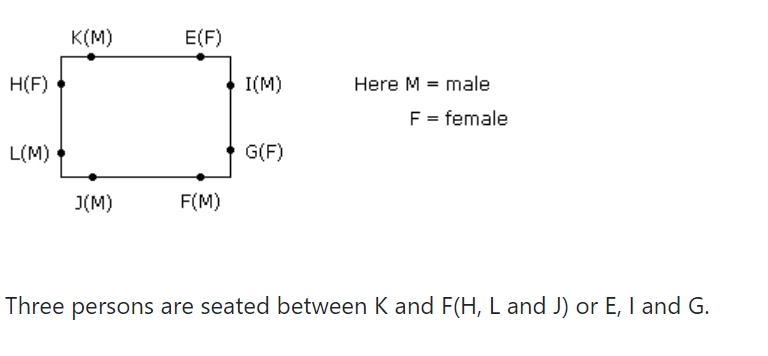
In this fixed order, K occupies seat 1 and F occupies seat 5. Tracing the arc forward from K (through E, I and G) reaches F after passing three occupied seats. Tracing the other arc backward from K (through H, L and J) also reaches F after passing three occupied seats.
Cross-check: the two arc counts above add up to the six seats other than K and F themselves, and every other clue in the puzzle - F opposite E, the lady seated between F and I, and the three ladies all being non-adjacent - is independently satisfied by this same fixed arrangement, confirming it is the unique seating consistent with all the given information.
Therefore, exactly three persons are seated between K and F.