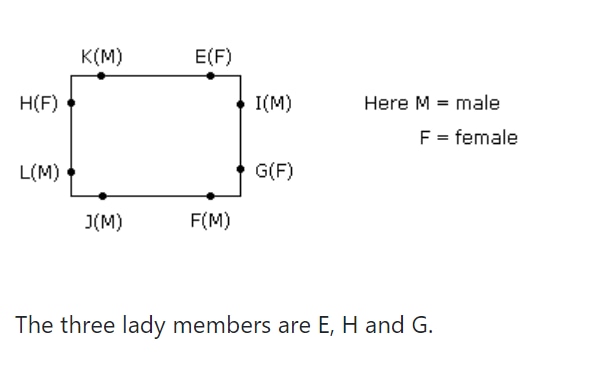
Each of these questions are based on the information given below: 8 persons E,…
2025
Each of these questions are based on the information given below: 8 persons E, F, G, H, I, J, K and L are seated around a square table - two on each side. There are 3 ladies who are not seated next to each other. J is between L and F. G is between I and F. H, a lady member, is second to the left of J. F, a male member, is seated opposite E, a lady member. There is a lady member between F and I. Who among the following are three lady members?
- A.
E, H and J
- B.
E, F and G
- C.
E, H and G
- D.
C, H and J
Attempted by 1 students.
Show answer & explanation
Correct answer: C
Concept
In a seating-arrangement puzzle where people occupy fixed positions around a shape (here a square table with two seats on each side), first convert every relational clue - between, second-to-the-left, opposite - into a single consistent seat-by-seat layout. Only once every person has a fixed seat can an attribute tied to a seat (such as gender here) be safely read off and cross-checked against the remaining conditions (like 'no two ladies adjacent').
Working out the seating layout
J is between L and F, so L, J and F occupy three consecutive seats, with J in the middle.
G is between I and F, so I, G and F are also three consecutive seats, sharing F with the L-J-F triple - this anchors F between G and J.
Since exactly two seats sit on each side, the bottom side holds F and J, and the right side holds I and G (I above G), completing one full quadrant of the table.
H is second to the left of J: counting two seats from J's position places H on the left side of the table.
The two seats left unplaced, K and E, must occupy the top side.
F is male and sits directly opposite E: with two seats per side, 'opposite' pairs the same-position seat on the far side, fixing E on the top side directly across from F.
F is explicitly male; H is explicitly stated to be a lady (female) member.
A lady member sits strictly between F and I: from the earlier steps the only seat between F and I is G, so G must be female.
E sits opposite the male F and is named directly as a lady member, confirming E is female.
This gives exactly three female seats - E, H and G. Checking the full seating ring (K, E, I, G, F, J, L, H, back to K) confirms no two of these three sit next to each other, satisfying the 'three ladies not seated next to each other' condition.
Cross-check
Each of the three ladies is anchored by a distinct, independent clue rather than a single chain of deduction: H is stated directly as a lady; E's gender follows straight from being named a lady opposite the male F; and G's gender follows separately from being the one seat that sits strictly between F and I once the layout is fixed. Three independent clues landing on exactly three different seats - with none of the other five seats touched by any of these clues - confirms E, H and G together, uniquely.
The three lady members are E, H and G.