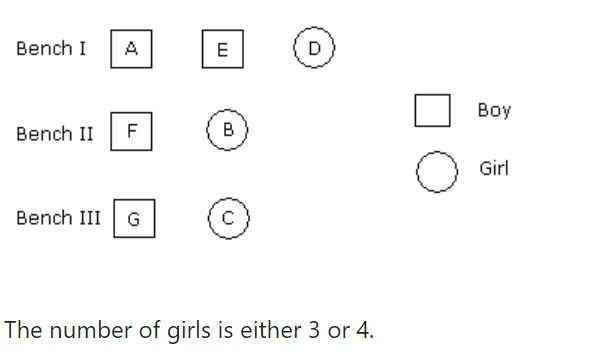
In a class there are seven students (including boys and girls) A, B, C, D, E,…
2025
In a class there are seven students (including boys and girls) A, B, C, D, E, F and G. They sit on three benches I, II and III. Such that at least two students on each bench and at least one girl on each bench. C who is a girl student, does not sit with A, E and D. F the boy student sits with only B. A sits on the bench I with his best friends. G sits on the bench III. E is the brother of C. How many girls are there out of these 7 students?
Answer: B. 3 or 4 — In a seating/grouping logic puzzle, after using every direct clue to fix as many seats and genders as certain as possible, check the puzzle's GLOBAL rule…
- A.
3
- B.
3 or 4
- C.
4
- D.
None
Attempted by 15 students.
Show answer & explanation
Correct answer: B
In a seating/grouping logic puzzle, after using every direct clue to fix as many seats and genders as certain as possible, check the puzzle's GLOBAL rule (here, "at least one girl on each bench") against EVERY bench. If a bench's already-fixed occupants include someone independently confirmed female, the rule is already satisfied on that bench - so any OTHER occupant there whose gender no clue fixes remains genuinely UNDETERMINED, and the final count must reflect both possibilities rather than being forced to one.
Seven students sit on three benches with at least two students on each bench, so the only way to split 7 into three parts each at least 2 is 3 + 2 + 2.
"F, the boy student, sits with only B" fixes one 2-seat bench as {F, B}. Since A is on bench I and G is on bench III, this {F, B} pair must be bench II.
"C does not sit with A, E and D" rules out bench I (where A sits) for C, so C shares the remaining 2-seat bench with G - bench III = {C, G}.
The only students left - A, D and E - must fill the 3-seat bench I.
The passage fixes four genders directly: F is called "the boy student" (male); C is called "a girl student" (female); E is "the brother of C" (male); and A is described as sitting "with his best friends" (the pronoun "his" marks A male).
Bench I = {A, D, E}: A and E are both male, so the "at least one girl on each bench" rule forces the third occupant, D, to be the girl on that bench (otherwise bench I would have no girl at all).
Bench II = {F, B}: F is male, so the same rule forces B to be the girl on that bench.
Bench III = {C, G}: C is already confirmed female, so bench III's rule is satisfied by C alone. Nothing in the passage fixes G's gender either way, so G could be a boy or a girl without breaking any stated condition.
Bench | Occupants | Girl(s) here |
|---|---|---|
I | A, D, E | D |
II | F, B | B |
III | C, G | C (G undetermined) |
Three girls - B, C and D - are fixed no matter what: B and D are forced by the bench rule, and C is stated directly. G's gender is the only genuinely open question: if G is a boy, the total is 3 girls; if G is a girl, the total is 4 girls. Both scenarios satisfy every condition in the passage equally well, so the number of girls among the seven students is not a single fixed value - it is 3 or 4.
This matches the note in the item's own accompanying diagram, which states: "The number of girls is either 3 or 4."