Eight colleagues H, I, J, K, L, M, N, and O are sitting surrounding an octagon…
2023
Eight colleagues H, I, J, K, L, M, N, and O are sitting surrounding an octagon table facing each other at different corners of the table. H is the second left to K. I is the neighbor of M and N. O is second left of N. L is between J and H. J is immediate to M. Who is sitting immediately to O?
- A.
L
- B.
K
- C.
J
- D.
M
Attempted by 1 students.
Show answer & explanation
Correct answer: B
In a circular or polygonal seating-arrangement puzzle, each clue such as "second left of", "neighbor of", "between X and Y", or "immediate to" fixes one person's seat relative to another already-placed person. With everyone facing the centre of the table, moving "left" means stepping one seat clockwise (as viewed from above) and moving "right" means stepping one seat counter-clockwise. Anchoring one person as a fixed reference and applying every clue in an order that lets each new person be placed unambiguously builds the complete ring, and a "who sits next to X" question is then read straight off it.
Fix K at a reference seat, seat 0.
"H is second left to K" places H two seats clockwise from K, i.e., at seat 2.
"L is between J and H" means one of L's two neighbours is H. Testing both seats next to H (seat 1 and seat 3) shows only seat 3 works, because the other neighbour of seat 1 is K, not J; so L is at seat 3, and J takes the remaining seat next to L, seat 4.
"J is immediate to M" means M is adjacent to J. Seat 3 (next to J) is already L, so M takes the only free seat next to J, seat 5.
"I is the neighbor of M and N" means I sits between M and N. Since M is at seat 5, I takes the free adjacent seat, seat 6, and N takes the seat on I's other side, seat 7.
"O is second left of N" places O two seats clockwise from N (seat 7), landing O at seat 1.
All eight seats are now filled exactly once — K, O, H, L, J, M, I, N — so the ring is unique and consistent with every clue.
Reading the two seats flanking O (seat 1) off the completed ring gives seat 0 (K) and seat 2 (H); the seating diagram below, drawn independently from the same clues, also places O between H and K, confirming the ring. Of O's two neighbours, only one appears among the given options.
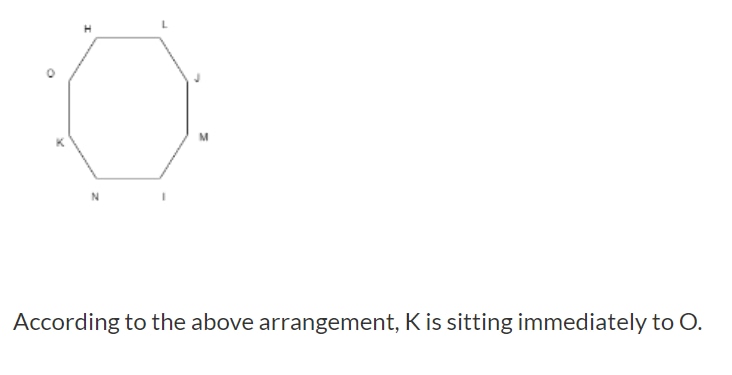
Therefore, K is seated immediately next to O.