Study the given information carefully and answer the given questions. Asha,…
2025
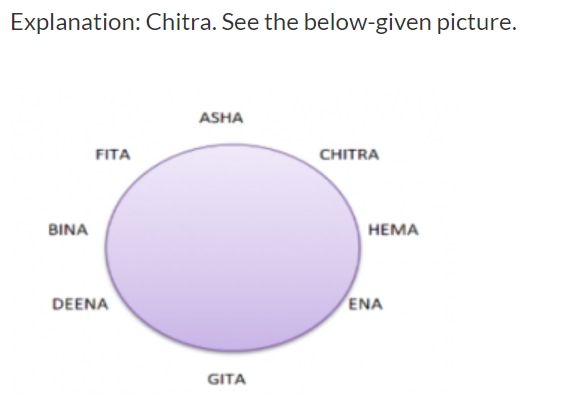
Study the given information carefully and answer the given questions. Asha, Bina, Chitra, Deena, Ena, Fita, Gita, and Hema are sitting around a circular table, facing the center. Gita is sitting third to the right of Fita. Hema is not an immediate neighbor of Fita and Gita. Asha is sitting second to the right of Hema. Bina is sitting third to the right of Chitra and Chitra is not an immediate neighbor of Gita. Deena is not an immediate neighbor of Hema or Chitra. Who is sitting exactly between Hema and Asha?
- A.
Bina
- B.
Geeta
- C.
Chitra
- D.
Ena
Attempted by 1 students.
Show answer & explanation
Correct answer: C
Concept: In a circular seating puzzle where everyone faces the centre, a clue such as "third to the right of X" or "second to the right of X" always moves a fixed number of seats in one consistent rotational sense from X's seat, and "immediate neighbour" means the seat directly on either side. Which physical direction (clockwise or anticlockwise, as seen from above) counts as "right" does not need to be fixed in advance - applying the SAME sense to every clue is what matters, because swapping the sense simply mirrors the whole seating, and a mirror image never changes who sits directly between two named people. Because the whole arrangement is only fixed relative to itself (it can be rotated as a block), you may anchor any one person's seat arbitrarily and then place everyone else using the direction and neighbour-restriction clues, discarding any placement that violates a later restriction, until exactly one arrangement survives.
Application:
Anchor Fita at seat 1 (numbering the seats 1-8 in the direction chosen to represent "right"). Since Gita sits third to the right of Fita, Gita takes seat 4 (1 -> 2 -> 3 -> 4).
Hema cannot be an immediate neighbour of Fita (seats 8 and 2) or of Gita (seats 3 and 5), and seats 1 and 4 are already taken. That leaves only seats 6 and 7 for Hema.
Test seat 7 for Hema: Asha, sitting second to the right of Hema, would then fall on seat 1 - but seat 1 is Fita's. This is impossible, so Hema must sit at seat 6, which places Asha at seat 8 (6 -> 7 -> 8).
Seats 2, 3, 5 and 7 remain for Bina, Chitra, Deena and Ena. Chitra cannot be an immediate neighbour of Gita (seats 3 and 5), so Chitra must sit at seat 2 or seat 7.
Test Chitra at seat 2: Bina, sitting third to the right of Chitra, would fall on seat 5. That leaves seats 3 and 7 for Deena and Ena - but Deena cannot neighbour Hema (seats 5, 7) or Chitra (seats 1, 3), which rules out both remaining seats. This case fails, so Chitra sits at seat 7.
With Chitra at seat 7, Bina (third to the right of Chitra) falls at seat 2 (7 -> 8 -> 1 -> 2). Seats 3 and 5 remain for Deena and Ena. Deena cannot neighbour Hema (seats 5, 7), which rules out seat 5, so Deena takes seat 3 and Ena takes seat 5.
The full arrangement (in the same direction, starting from seat 1) is: Fita, Bina, Deena, Gita, Ena, Hema, Chitra, Asha.
Cross-check: every original condition holds against this final seating -
Gita (seat 4) is third to the right of Fita (seat 1). Confirmed.
Hema (seat 6) neighbours seats 5 and 7 (Ena and Chitra), not Fita or Gita. Confirmed.
Asha (seat 8) is second to the right of Hema (seat 6). Confirmed.
Bina (seat 2) is third to the right of Chitra (seat 7), and Chitra neighbours seats 6 and 8 (Hema and Asha), not Gita. Confirmed.
Deena (seat 3) neighbours seats 2 and 4 (Bina and Gita), not Hema or Chitra. Confirmed.
Hema sits at seat 6 and Asha sits at seat 8, so the seat lying exactly between them (seat 7) belongs to Chitra.