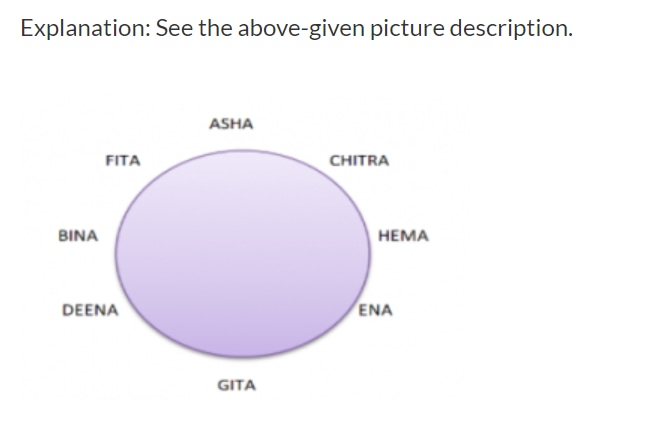
Asha, Bina, Chitra, Deena, Ena, Fita, Gita, and Hema are sitting around a…
2025
Asha, Bina, Chitra, Deena, Ena, Fita, Gita, and Hema are sitting around a circular table, facing the center. Gita is sitting third to the right of Fita. Hema is not an immediate neighbour of Fita and Gita. Asha is sitting second to the right of Hema. Bina is sitting third to the right of Chitra and Chitra is not an immediate neighbour of Gita. Deena is not an immediate neighbour of Hema or Chitra. What is the position of Ena with respect to Asha?
- A.
Third to the left
- B.
Third to the right
- C.
Second to the left
- D.
Second to the right
Attempted by 3 students.
Show answer & explanation
Correct answer: A
Concept
In a circular seating arrangement where everyone faces the centre, the left/right sense is reversed compared to arrangements where people face outward: moving to a person's right actually corresponds to the anticlockwise direction around the table, and moving to their left corresponds to the clockwise direction. So being k seats to the right of X means k seats anticlockwise from X, and k seats to the left of X means k seats clockwise from X. Fix one seat as a reference, translate every clue into a position equation (mod 8), and eliminate seats ruled out by the negative ("not a neighbour of") clues until a single consistent seating survives.
Application
Fix Fita's seat as position 0. Gita is third to the right of Fita, so Gita is at position 3 (right = anticlockwise, so 0 + 3 = 3).
Hema cannot be an immediate neighbour of Fita (so not at position 7 or 1) or of Gita (so not at position 2 or 4); of the remaining seats, only position 5 or position 6 stays open for Hema.
Asha sits second to the right of Hema. If Hema were at position 6, Asha would land at position 0 (6 + 2 = 8 ≡ 0), but that seat already belongs to Fita, so Hema must be at position 5, which puts Asha at position 7 (5 + 2 = 7).
Bina sits third to the right of Chitra, and Chitra cannot be an immediate neighbour of Gita (so not at position 2 or 4). Of the seats still open (1, 2, 4, 6), Chitra can only be at position 1 or position 6.
Testing Chitra at position 1 would put Bina at position 4 (1 + 3 = 4), leaving only positions 2 and 6 for Deena — but position 2 neighbours Chitra and position 6 neighbours Hema, and the next clue rules both out for Deena, so this branch collapses.
So Chitra must be at position 6, which puts Bina at position 1 (6 + 3 = 9 ≡ 1), leaving positions 2 and 4 open for Deena and Ena.
Deena cannot be an immediate neighbour of Hema (not position 4 or 6) or of Chitra (not position 5 or 7); of the two open seats, only position 2 satisfies this, so Deena takes position 2 and Ena takes the last open seat, position 4.
Asha is at position 7 and Ena is at position 4: the gap from Asha to Ena is 3 seats in the clockwise direction (7 → 6 → 5 → 4), and clockwise is the left-hand direction in this centre-facing arrangement, so Ena sits third to the left of Asha.
Cross-check
Gita (3) is third to the right of Fita (0): 0 + 3 = 3.
Hema (5) is not an immediate neighbour of Fita (0, neighbours 7 and 1) or of Gita (3, neighbours 2 and 4).
Asha (7) is second to the right of Hema (5): 5 + 2 = 7.
Bina (1) is third to the right of Chitra (6): 6 + 3 = 9 ≡ 1; Chitra (6) is not an immediate neighbour of Gita (3, neighbours 2 and 4).
Deena (2) is not an immediate neighbour of Hema (5, neighbours 4 and 6) or of Chitra (6, neighbours 5 and 7).
Every clue is satisfied by exactly one seating, which also matches the order shown in the reference diagram (clockwise from Asha: Asha, Chitra, Hema, Ena, Gita, Deena, Bina, Fita).
Result
So Ena sits third to the left of Asha.
Reference diagram of the final seating (viewed from above, everyone facing the centre):