Select the correct answer from given options.
2024
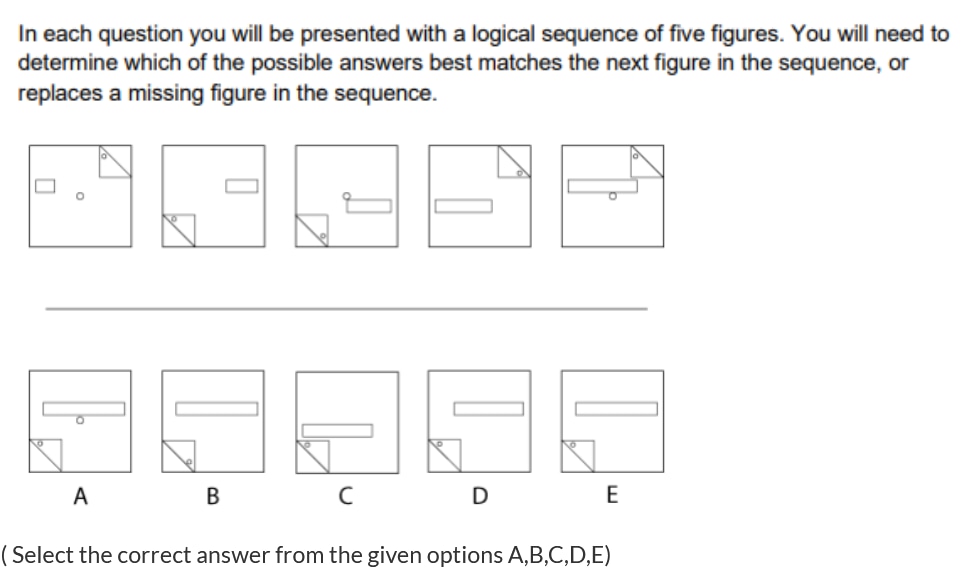
Select the correct answer from given options.
Answer: E. E — Concept: Figure-series items like this test whether you can isolate, for each visual element in the sequence, an independent transformation rule -- a pattern…
- A.
A
- B.
B
- C.
C
- D.
D
- E.
E
Attempted by 11 students.
Show answer & explanation
Correct answer: E
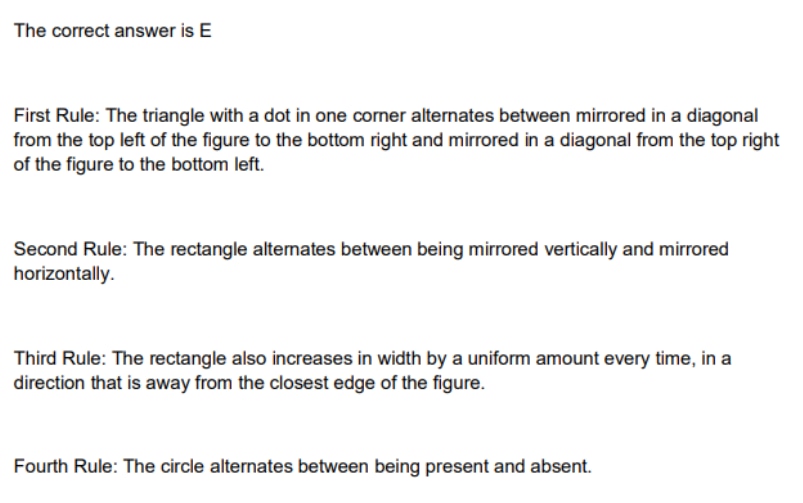
Concept: Figure-series items like this test whether you can isolate, for each visual element in the sequence, an independent transformation rule -- a pattern in position, orientation, size, or presence -- that must hold across every consecutive pair of figures, then apply every one of those rules simultaneously to project the next figure in the series.
Application: Comparing every consecutive pair of figures across the five given steps isolates four independent rules governing the three changing elements (a right-angled corner triangle carrying a small dot, a rectangle, and a small circle):
Triangle rule -- the corner triangle (with its dot) alternates between being mirrored along the top-left-to-bottom-right diagonal and mirrored along the top-right-to-bottom-left diagonal.
Rectangle-orientation rule -- the rectangle alternates between being mirrored vertically and mirrored horizontally from one step to the next.
Rectangle-width rule -- the rectangle's width increases by a uniform amount at every step, growing in the direction away from the edge of the figure it sits closest to.
Circle rule -- the circle alternates between being present and being absent at each step.
Applying all four rules to the fifth figure to project the sixth (the missing figure asked for): the circle -- present in the fifth figure -- must flip to absent (Rule 4); the rectangle must widen by the same uniform amount again, growing away from its nearest edge (Rule 3); the rectangle's mirrored orientation must flip again (Rule 2); and the triangle-and-dot must continue the established mirror alternation (Rule 1), with no extra or duplicated shapes introduced.
Cross-check against the given choices:
The choice that still shows the circle beneath the rectangle breaks the presence/absence alternation (Rule 4).
The choice whose rectangle is visibly narrower than the required uniform increase breaks the width rule (Rule 3).
The choice showing an extra, duplicated rectangle segment introduces an element none of the four rules calls for.
The choice whose triangle-dot placement does not continue the established mirror alternation breaks Rule 1.
Only one option satisfies all four rules simultaneously -- circle absent, rectangle uniformly widened away from its nearest edge, rectangle orientation flipped again, and the triangle-and-dot mirror alternation correctly continued -- so that is the figure that completes the sequence.