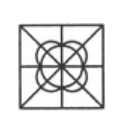
Identify the figure that completes the pattern.
2024
Identify the figure that completes the pattern.

- A.
1
- B.
2
- C.
3
- D.
4
Show answer & explanation
Correct answer: C
Concept: In a figure-completion series built on a 2x2 grid, the whole square is generated by rotating one base quadrant by a fixed step angle (here, 90 degrees) about the centre, going around the four quadrants in order. So every quadrant repeats the same two elements in rotated position: a straight line from its own outer corner to the centre, and a curved arc whose bulge always faces the centre. Two quadrants that are diagonally opposite each other, such as top-left and bottom-right, are therefore two such steps apart, that is, related by 180 degrees.
Application: The three given quadrants already follow this rule. In the top-left quadrant, the diagonal runs from the top-left corner to the centre and the arc bulges toward the centre. In the top-right quadrant, the diagonal runs from the top-right corner to the centre and the arc again bulges toward the centre. In the bottom-left quadrant, the same pattern repeats with the diagonal from the bottom-left corner to the centre. Rotating the top-left quadrant by 180 degrees about the centre must therefore produce the missing bottom-right quadrant: a diagonal from the bottom-right corner to the centre, with the arc bulging toward the centre on the matching rotational side.
Checking each option against this rule: the figure marked 1 has its arc bulging toward the outer corner instead of the centre; the figure marked 2 has the arc mirrored to the wrong side of the diagonal; the figure marked 4 carries an extra curved loop that no quadrant in the pattern has; only the figure marked 3 places both the diagonal and the centre-facing arc exactly as the rule requires.
Cross-check: Applying the same 180-degree relation to the top-right and bottom-left quadrants, which are also diagonally opposite each other, reproduces one from the other exactly, confirming that the 90-degree-step rule does correctly give a 180-degree relation between diagonal opposites in this figure. Using that verified relation on the top-left and bottom-right pair confirms the figure marked 3 as the unique completion, and placing it in the missing corner reproduces the fully symmetric four-petal design.