Identify the figure that completes the pattern.
2024
Identify the figure that completes the pattern.

- A.
1
- B.
2
- C.
3
- D.
4
Attempted by 2 students.
Show answer & explanation
Correct answer: C
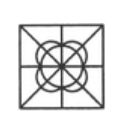
Concept: In a rotational figure-completion puzzle, the full figure is built from ONE motif repeated at fixed 90-degree rotational steps around a shared centre point. Every quadrant must therefore keep two things consistent with its neighbours: the straight-line elements (here, the diagonal that runs from the quadrant's own outer corner to the centre) and the curved elements (here, the arc-lobe of the flower, which always sits at the corner touching the centre, never at the free outer corner).
Application:
The whole square is crossed by both its diagonals and split into four quadrants by the two medians, with a four-lobed floral motif overlapping at the centre.
In the top-left quadrant, the diagonal runs from its own top-left (outer) corner to its bottom-right corner (the centre), and the arc-lobe sits at that same bottom-right, centre-touching corner.
In the top-right quadrant, the diagonal runs from its top-right (outer) corner to its bottom-left corner (the centre), and its arc-lobe again sits at the centre-touching corner, not the outer one.
In the bottom-left quadrant, the diagonal runs from its bottom-left (outer) corner to its top-right corner (the centre), with the arc-lobe once more converging at the centre-touching corner.
Applying the same rule to the missing bottom-right quadrant: its diagonal must run from its top-left corner (the centre) to its bottom-right corner (the outer corner of the whole square, continuing the same diagonal as the top-left quadrant), and its arc-lobe must converge at that top-left, centre-touching corner.
Cross-check:
The candidate whose diagonal runs from the bottom-left corner to the top-right corner breaks the pattern outright -- every other quadrant's diagonal runs the other way, continuing the square's own two main diagonals.
The candidate whose arc-lobe sits at the outer (bottom-right) corner instead of the centre-touching corner also breaks the rule seen in all three given quadrants.
A third candidate keeps the correct diagonal but stretches its arc-lobe across the edge instead of tucking it tightly into the centre-touching corner the way the other three quadrants do.
Only the remaining candidate keeps both the diagonal direction and the tight, centre-converging arc-lobe consistent with the rest of the figure. This matches the candidate figure printed "3", which is the correct answer.