Identify the figure that completes the pattern.
2025
Identify the figure that completes the pattern.

- A.
1
- B.
2
- C.
3
- D.
4
Attempted by 1 students.
Show answer & explanation
Correct answer: D
Concept: In a rotational figure-completion series, one small design repeats around a common centre, each copy turned by the same fixed angle as the one before it (here 90 degrees, since the whole figure has four quadrants). To complete such a figure, the missing quadrant must be an exact copy of the given quadrants turned by that same angle - so every feature of the design (the curve, the crossing lines, and the shaded strip on the curve) must sit in the same position relative to its own quadrant boundary as it does in every other quadrant.
Each visible quadrant is a small square cut by its own two diagonals into an X, with a curved boundary bulging toward the outer corner and a short shaded strip on that curve.
In the top-left quadrant, the shaded strip sits right next to the boundary line the quadrant shares with the quadrant to its right (the one the pattern turns into next).
In the top-right quadrant, the shaded strip again sits next to the boundary it shares with the quadrant below it - the same next-in-rotation position, now turned by 90 degrees.
In the bottom-right quadrant, the shaded strip once more sits next to the boundary it shares with the following quadrant in the turn - confirming the rule holds every 90 degrees.
Carrying the same rule to the missing bottom-left quadrant: its shaded strip must sit at the end of its curve that is adjacent to the quadrant that follows it in the turn, which is the top-left quadrant - not at the end adjacent to the bottom-right quadrant.
Only one figure keeps the same quarter-circle curve as the other three quadrants AND places a short shaded strip at that correct end of the curve (the end adjacent to the top-left quadrant); the remaining figures either place the shaded strip at the other end of the curve, stretch it across most of the curve, or change the curve's own path altogether.
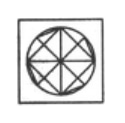
Cross-check: Placing that quadrant into the blank corner completes the circle into a symmetric wheel cut by a vertical line, a horizontal line, and both diagonals into eight equal sectors - exactly the reference wheel shown below, confirming the same figure independently of the rotation argument.