Select a figure from amongst the four alternatives, which when placed in the…
2025
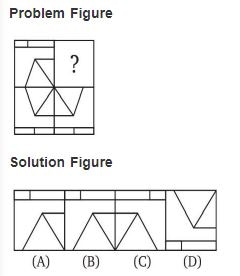
Select a figure from amongst the four alternatives, which when placed in the blank space of problem figure would complete the pattern.
- A.
A
- B.
B
- C.
C
- D.
D
Attempted by 2 students.
Show answer & explanation
Correct answer: C
In a mirror-symmetry figure-completion question, the panel that sits opposite the blank space, reflected about the figure's own axis of symmetry, fixes exactly what outline, internal fold, and border proportions the missing panel must reproduce. The correct completion is the one candidate that reflects that panel left-to-right about the axis, not the one that copies it unchanged or borrows a motif from an unrelated cell.
Here the box is divided into four cells meeting at a common centre point, with a vertical axis of symmetry running through that centre. The lower-left and lower-right cells already trace the bottom half of a symmetric hexagon (the lower-right cell also carries an extra wedge/notch that sits outside the hexagon's own outline there, and belongs only to that cell). The upper-left cell shows a triangle with a flat “shelf” edge on its right side and a diagonal edge running down to the hexagon's far-left vertex; its own top border-bar is split by a tick mark placed close to its left corner, at roughly one-third of the bar's width. Reflecting the upper-left cell about the vertical axis, the missing upper-right cell must show the same shelf-and-diagonal shape flipped left-to-right — shelf on the LEFT edge this time, diagonal running down to the lower-right corner — and its own top-bar tick must sit at the mirrored position, about two-thirds of the way across (the left segment of that bar now the longer of the two).
Checking each candidate panel against this mirror requirement:
the panel that repeats the upper-left cell's shelf-on-the-right, diagonal-to-lower-left shape unchanged, with its tick still sitting close to its own left corner — it duplicates the given cell instead of reflecting it;
the panel showing a plain, evenly-sloped triangle with no shelf edge at all — it drops the flat border detail that every other cell in the figure carries;
the panel that stretches the lower-right cell's separate wedge/notch — the shape that already sits outside the hexagon's own outline there — across the whole blank space, borrowing the wrong cell's motif entirely;
the panel labelled C, whose shelf sits on the left edge, whose diagonal runs to the lower-right corner, and whose top-bar tick shifts to the mirrored two-thirds position — the true left-right reflection of the upper-left cell, completing the figure's symmetry.
So the panel labelled C is the one that completes the pattern.