Which of the following finished patterns can be obtained from the piece of…
2025
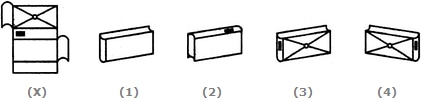
Which of the following finished patterns can be obtained from the piece of cardboard (X) shown below?
- A.
1
- B.
2
- C.
3
- D.
4
Attempted by 5 students.
Show answer & explanation
Correct answer: A
When a flat net of joined rectangular panels is folded into a box, two rules always hold: first, two panels that share a fold line in the net become two faces that meet along a physical edge on the box, running in the same direction as that fold line; second, whatever pattern is drawn on a panel folds along with that panel only — it keeps its own position and size on that one face and can never spread across a fold line onto a neighbouring panel's face. Any pictured box that breaks either rule cannot be the result of folding the given net.
In fig (X), label the four panels top to bottom: Panel 1 carries the crosshatch pattern with a centre dot, Panel 2 (a much shorter strip) carries the small black rectangle, and Panels 3 and 4 are blank. The fold lines between Panel 1-Panel 2, Panel 2-Panel 3 and Panel 3-Panel 4 all run across the strip in the same direction, so on the folded box the crosshatch face and the black-mark face can only ever meet along a long edge — never along a short end edge.
Folding a four-panel strip into a box always sends panels that are two positions apart to opposite faces: so the crosshatch face (Panel 1) ends up opposite the blank tall face (Panel 3), and the black-mark face (Panel 2) ends up opposite the blank short face (Panel 4).
Since the crosshatch face and the black-mark face are adjacent to each other only along a long edge (never a short end edge, per the rule above), there is a valid way to orient the finished box - the same way these figures are conventionally drawn, showing the front, the top, and one end - that puts both patterned faces on the far side together, on the back and the underside. In that orientation, every face actually shown to the viewer is blank.
Checking each candidate figure against these two rules:
Fig (2) places the small black mark at the right end of the thin face, but in fig (X) that same mark sits near the left edge of its own panel, not the right. A fold carries a mark's own left/right position on its face along with it, so the mark could not shift to the opposite end like this.
Fig (3) shows the black rectangle as a short end face touching the crosshatch face directly. Rule one above rules this out: the crosshatch panel and the black-mark panel can only meet along a long edge, never a short end edge.
Fig (4) makes the same mistake as fig (3), just mirrored to the other end — the black-mark face is still drawn meeting the crosshatch face along a short end edge, which the fold lines of fig (X) do not allow.
Fig (1) is the only figure that keeps both patterned panels off the visible faces entirely, matching what the fold lines predict.
Hence, fig (1) — the plain box with no visible pattern — is the finished shape obtainable by folding fig (X).