The sheet of paper shown in figure (X) is folded to form a box (cube). From…
2025
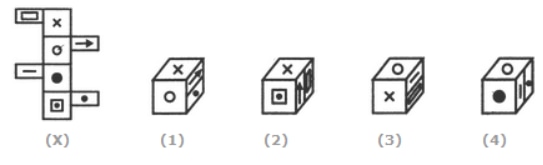
The sheet of paper shown in figure (X) is folded to form a box (cube). From the alternatives (1), (2), (3) and (4), choose the box(es) that can be formed by folding this sheet.
Answer: B. 1 and 3 only. — When four squares of a net are joined in a single straight strip, folding the strip into a cube makes the 1st and 3rd squares land on opposite faces of the…
- A.
1 and 2 only
- B.
1 and 3 only.
- C.
3 and 4 only
- D.
1, 2, 3 and 4
Attempted by 12 students.
Show answer & explanation
Correct answer: B
When four squares of a net are joined in a single straight strip, folding the strip into a cube makes the 1st and 3rd squares land on opposite faces of the cube, and the 2nd and 4th squares land on opposite faces too — never on adjacent faces. Two faces that are opposite on a cube can never both be visible in any 3-D view of the folded cube.
Reading the strip in sheet (X) from top to bottom — 'x', the white circle, the black dot, and the square-with-a-dot — apply the rule above:
'x' (1st square) is opposite the black dot (3rd square).
The white circle (2nd square) is opposite the square-with-a-dot (4th square).
So a valid cube folded from this sheet can never show 'x' together with the black dot, and can never show the white circle together with the square-with-a-dot.
Figure | Faces shown together | Check |
|---|---|---|
(1) | 'x' and the white circle | Not the opposite pair — possible |
(2) | The white circle and the square-with-a-dot | This is the opposite pair — impossible |
(3) | The white circle and 'x' | Not the opposite pair — possible |
(4) | The white circle and the square-with-a-dot | This is the opposite pair — impossible |
Cross-check: figures (1) and (3) are simply the same 'x' / white-circle corner of the cube seen from two different rotations, so both are genuinely achievable. Figures (2) and (4) each pair the white circle with the square-with-a-dot, the one combination the net rules out, so neither can be folded from sheet (X).
Therefore, only the cubes in figures (1) and (3) can be formed from sheet (X).