Find out which of the figures (1), (2), (3) and (4) can be formed from the…
2025
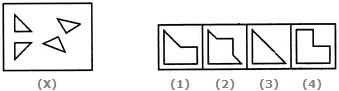
Find out which of the figures (1), (2), (3) and (4) can be formed from the pieces given in figure (X).
- A.
1
- B.
2
- C.
3
- D.
4
Attempted by 2 students.
Show answer & explanation
Correct answer: C
In a ‘formation of figures’ reasoning problem, each scattered piece may only be rotated — never resized, stretched, or mirrored — before being reassembled edge-to-edge with no gaps or overlaps. A candidate option is correct only when its complete outline, including any internal lines the touching pieces leave behind, exactly matches the outline the given pieces actually produce when correctly placed.
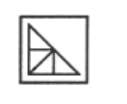
Figure (X) supplies four right-angled triangular pieces — two smaller and two larger, in matching pairs. Rotated (not flipped) into place, they close up into a single larger right triangle set inside a square, with the joins between the pieces showing up as two internal lines meeting on the triangle's slanted edge — exactly the outline traced in the accompanying figure.
The outline that pairs a slanted upper edge with a right-angled step lower down has a different silhouette altogether — it is not the plain triangular profile the four pieces actually close up into.
The outline with a smaller, differently placed step has the same mismatch — its notched profile is not the triangular silhouette these pieces produce.
The outline built only from horizontal and vertical edges, with no slanted edge at all, is missing the diagonal that these pieces' hypotenuses leave along the outer edge once assembled.
Only the plain right triangle set inside the square, split by the two internal lines into regions matching the four given pieces, reproduces the exact outline these pieces form once correctly assembled. That confirms the figure labelled ‘3’ is the one that can be formed from the pieces in figure (X).