Find out which of the figures (1), (2), (3) and (4) can be formed from the…
2023
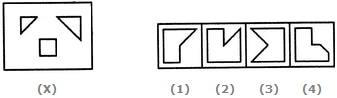
Find out which of the figures (1), (2), (3) and (4) can be formed from the pieces given in figure (X).
- A.
1
- B.
2
- C.
3
- D.
4
Attempted by 3 students.
Show answer & explanation
Correct answer: A
Concept:
In an “assembling the given pieces into a figure” question, the cut-out pieces must be joined edge to edge with no overlap and no gap, keeping each piece’s own size and shape (only turning/rotating a piece is allowed, never flipping it over). The figure whose outer outline exactly matches the boundary produced by this joining is the answer.
Application:
Figure (X) gives three pieces: a small right-angled triangle, a clearly larger right-angled triangle, and a small square (about the same size as the small triangle).
Place the smaller triangle directly above the square, with one straight edge of the triangle flush against the top edge of the square — this gives a single continuous straight edge running down the left side.
Place the larger triangle beside the smaller one so that the two slanting (hypotenuse) edges of the triangles meet at one common point, with their flat (non-slanting) edges forming one continuous straight top edge.
Because the two triangles differ in size, their meeting point sits below the top edge, leaving one slanting edge running from the top-right corner down to that point, and a second, shorter slanting edge running from that point back up to the top of the square — producing a single step/notch in the outline, not a symmetric pair of notches.
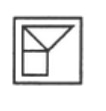
This join produces the outline shown in figure (1): a wide diagonal top that steps down once to a narrower, straight-sided base.
Cross-check:
Figure (2)’s notch is symmetric — equal on both sides of its peak. That kind of notch can only come from two triangles of the same size, but the pieces in figure (X) are one small and one clearly larger triangle, so joining them can never leave two identical notches like this.
Figure (3)’s notch opens toward the left. Producing a slant facing that direction would need one triangle flipped into its mirror image; turning (rotating) the given pieces in place never does that.
Figure (4) keeps a full right angle where the pieces would meet, with only one small diagonal cut elsewhere — much shorter than the hypotenuse of either triangle in figure (X). Neither triangle piece is anywhere near that small, so this shape’s tiny diagonal cannot belong to either of them.
Result:
Only figure (1) matches the outline formed by joining the two triangles and the square from figure (X).