Question :
2023
Question :
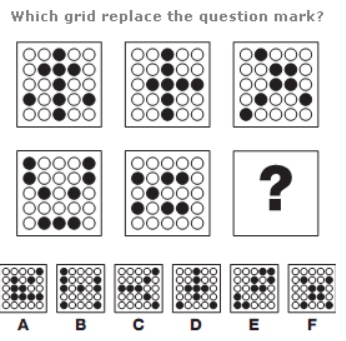
- A.
A
- B.
B
- C.
C
- D.
D
- E.
E
- F.
F
Show answer & explanation
Correct answer: E
In a figure-matrix (grid analogy) item, each row of three grids obeys one fixed transformation rule per column: the first grid in a row is symmetric about a vertical axis (mirror left-right), the second grid is symmetric about a horizontal axis (mirror top-bottom), and the third grid is symmetric about the diagonal running from the bottom-left corner to the top-right corner - every filled circle must have a matching filled circle at its mirrored position across that diagonal.
In the first row, the left grid's rows read the same forwards and backwards (vertical-axis symmetry), the middle grid's top and bottom halves mirror each other (horizontal-axis symmetry), and the already-shown right grid has every filled circle matched across the bottom-left-to-top-right diagonal - this fixes the column rule.
In the second row, the left grid again shows vertical-axis symmetry and the middle grid again shows horizontal-axis symmetry, confirming the same column rule repeats in every row.
So the missing third grid of the second row must satisfy diagonal symmetry: for every filled circle at row r, column c, the mirrored cell at row (n minus 1 minus c), column (n minus 1 minus r) must also be filled, with no exceptions.
Checking each candidate grid against this rule: one candidate is symmetric about the vertical axis instead (the column-1 rule, not column-3); others have several filled circles whose mirrored partner across the diagonal is empty; only one candidate has every filled circle correctly mirrored across the diagonal.
As an independent check, pick any filled circle in the fitting grid and trace it to its mirrored position across the bottom-left-to-top-right diagonal - it is filled every time, with zero exceptions, unlike every other candidate which breaks the rule at one or more cells.
So the grid that completes the pattern is the one showing full symmetry about the bottom-left-to-top-right diagonal - Answer: E.