Read the given information carefully and answer the questions given beside: (A…
2025
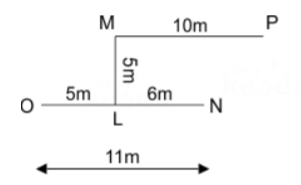
Read the given information carefully and answer the questions given beside: (A set of 2 questions) Point M is 5 meters towards the North of Point L. Point P is 10 meters towards the East of point M. Point N is 6 meters towards the East of point L. Point O is 11 meters towards the West of point N.
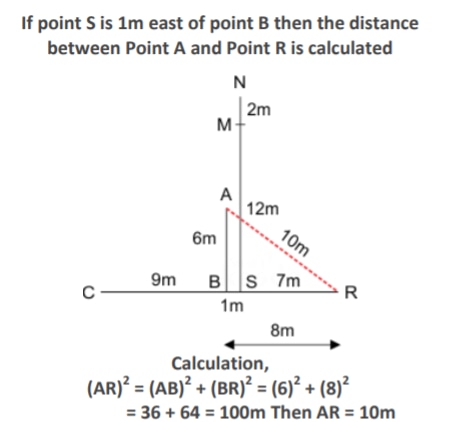
Point A is 6m north of point B. Point C is 9m west of point B. Point R is 7m east of point S which is 12m south of point M. Point N is 2m north of point M. If point S is 1m east of point B then, what is the distance between Point A and Point R?
- A.
6 m
- B.
8 m
- C.
10 m
- D.
12 m
Show answer & explanation
Correct answer: C
In direction-and-distance problems, when two points are reached from a common reference point by movements along perpendicular directions (one purely north-south, the other purely east-west), the straight-line distance between those two points is the hypotenuse of a right triangle formed at that reference point: distance = √(north-south leg² + east-west leg²), by the Pythagorean theorem.
Take point B as the common reference. Point A is 6m directly north of B, so the north-south leg AB = 6m.
Point S is 1m east of B, and point R is a further 7m east of S, so R lies 1 + 7 = 8m east of B along the same east-west line through B. This gives the east-west leg BR = 8m.
Since AB runs purely north-south from B and BR runs purely east-west from B, the angle at B between them is 90°, making triangle ABR right-angled at B.
Apply the Pythagorean theorem: AR2 = AB2 + BR2 = 62 + 82 = 36 + 64 = 100, so AR = √100 = 10m.
As an independent check, place B at the origin (0, 0). Then A = (0, 6) since it is 6m north, S = (1, 0) since it is 1m east, and R = (8, 0) since it is 8m east. The distance AR = √[(8−0)² + (6−0)²] = √(64+36) = √100 = 10m — the same result, and (6, 8, 10) is a well-known Pythagorean triple, confirming the answer independently.