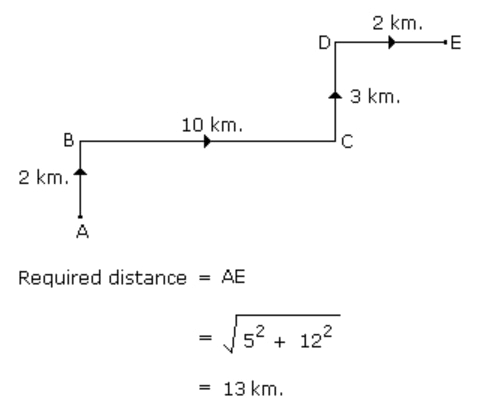
A man walks 2 km towards North. Then he turns to East and walks 10 km. After…
2023
A man walks 2 km towards North. Then he turns to East and walks 10 km. After this he turns to North and walks 3 km. Again he turns towards East and walks 2 km. How far is he from the starting point?
- A.
10 km
- B.
13 km
- C.
15 km
- D.
None of these
Attempted by 1 students.
Show answer & explanation
Correct answer: B
Concept: When a path consists of alternating perpendicular North/South and East/West legs, the straight-line distance from the starting point equals the hypotenuse of a right triangle whose two legs are the net north-south displacement and the net east-west displacement, related by the Pythagorean theorem.
Add the northward legs to get the net north-south displacement: 2 km + 3 km = 5 km.
Add the eastward legs to get the net east-west displacement: 10 km + 2 km = 12 km.
Apply the Pythagorean theorem to these two perpendicular legs: distance = √(52 + 122) = √(25 + 144) = √169 = 13 km.
Cross-check: 52 + 122 = 25 + 144 = 169 = 132 — this is the well-known 5-12-13 Pythagorean triple, confirming the result.