After walking 6 km, I turned to the right and then walked 2 km. After then I…
2024
After walking 6 km, I turned to the right and then walked 2 km. After then I turned to the left and walked 10 km. In the end, I was moving towards the North. From which direction did I start my journey?
- A.
North
- B.
South
- C.
East
- D.
West
Attempted by 1 students.
Show answer & explanation
Correct answer: B
Concept: In a direction-sense problem, a right turn rotates your facing direction 90° clockwise (North → East → South → West → North) and a left turn rotates it 90° counter-clockwise. Once every leg's direction is fixed this way, each leg becomes a displacement vector along the East–West and North–South axes, and adding the vectors gives the position of any point relative to any other.
The final (third) leg is given as North. Turning left onto this leg means the second leg's direction, rotated 90° counter-clockwise, gives North — so the second leg's direction is East.
Turning right onto the second leg means the first leg's direction, rotated 90° clockwise, gives East — so the first leg (the start of the journey) was also directed North.
Place the middle turning point B at the origin (0, 0), with East as +x and North as +y.
The first leg goes from A to B along North for 6 km, so A = B − (0, 6) = (0, −6): A lies 6 km south of B.
The second leg goes from B to C along East for 2 km, so C = B + (2, 0) = (2, 0): C lies 2 km east of B.
The third leg goes from C to D along North for 10 km, so D = C + (0, 10) = (2, 10).
Comparing the start point A (0, −6) with the end point D (2, 10), the displacement from D back to A is (−2, −16) — 16 km south and only 2 km west. Since the north–south component (16 km) dominates the small east–west offset (2 km), and the option list offers only the four cardinal directions, the start point A is identified as lying to the south of the destination D.
Diagram of the path (as given with the source solution):
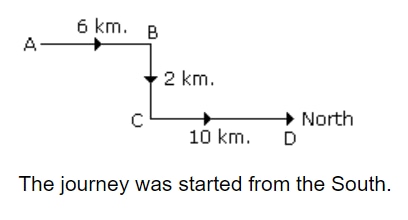
Hence, the journey started from the South.