A child went 90 m in the East to look for his father, then he turned right and…
2023
A child went 90 m in the East to look for his father, then he turned right and went 20 m. After this he turned right and after going 30 m he reached to his uncle's house. His father was not there. From there he went 100 m to his north and met his father. How far did he meet his father from the starting point?
- A.
80 m
- B.
100 m
- C.
140 m
- D.
260 m
Attempted by 2 students.
Show answer & explanation
Correct answer: B
Direction-sense (distance-and-direction) problems are solved by fixing East and North as the positive x- and y-axes; every 'turn right' or 'turn left' rotates the direction of travel by 90° in a fixed sense. The straight-line distance between the start and end points is then the hypotenuse of a right triangle whose legs are the NET east-west displacement and the NET north-south displacement, found using the Pythagorean theorem: distance = √((net E-W)2 + (net N-S)2).
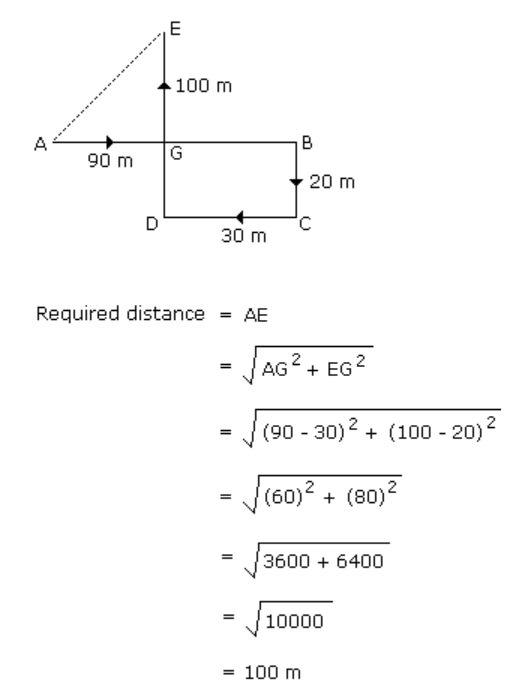
Let the starting point be A. The child walks 90 m East to point B.
At B he turns right (facing East, a right turn means he now faces South) and walks 20 m to point C.
At C he turns right again (facing South, a right turn means he now faces West) and walks 30 m to point D, his uncle's house.
From D he walks 100 m North to point E, where he meets his father.
Net east-west displacement: 90 m East − 30 m West = 60 m East.
Net north-south displacement: 100 m North − 20 m South = 80 m North.
Straight-line distance AE = √(602 + 802) = √(3600 + 6400) = √10000 = 100 m.
Cross-check: 60, 80, 100 is a Pythagorean triple (a scaled-up 3-4-5 right triangle), confirming the arithmetic; adding the four displacement vectors (90 m East, 20 m South, 30 m West, 100 m North) directly also resolves to the same net vector of 60 m East and 80 m North.
So the child met his father 100 m from the starting point.