Radha moves towards South-East a distance of 7 km, then she moves towards West…
2025
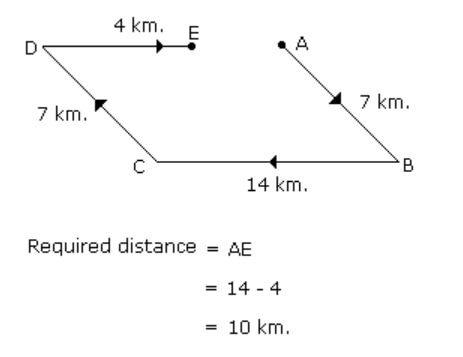
Radha moves towards South-East a distance of 7 km, then she moves towards West and travels a distance of 14 km. From here she moves towards North-West a distance of 7 km and finally she moves a distance of 4 km towards east. How far is she now from the starting point?
- A.
3 km
- B.
4 km
- C.
10 km
- D.
11 km
Attempted by 1 students.
Show answer & explanation
Correct answer: C
In direction-sense (path-tracing) problems, when two legs of a path are equal in length but point in exactly opposite compound directions - such as South-East and North-West, or North-East and South-West - their combined displacement is zero, because the two directions lie along the very same line but in reverse senses. Once such a pair is set aside, the remaining legs are combined along their own axis by simple addition or subtraction, and the straight-line (displacement) distance from the start is found from whatever net components remain.
Take East as the positive x-direction and North as the positive y-direction, with the starting point as the origin.
The South-East leg of 7 km and the North-West leg of 7 km are equal in length and are exactly opposite in direction (South-East is the reverse of North-West), so together they contribute zero net displacement.
The diagonal legs having cancelled entirely, only the horizontal displacements from the West leg (14 km) and the East leg (4 km) remain to be combined.
Combining these two along the east-west axis: 14 km West minus 4 km East gives a net horizontal displacement of 10 km West, while the net vertical displacement stays 0 (since the diagonal pair contributed none).
Since the entire net displacement lies along the east-west axis alone, with zero net vertical component, the straight-line distance from the starting point equals this net horizontal value.
Cross-check with components: South-East (7 km) -> (7/sq.rt(2), -7/sq.rt(2)); West (14 km) -> (-14, 0); North-West (7 km) -> (-7/sq.rt(2), 7/sq.rt(2)); East (4 km) -> (4, 0). Adding all four, the diagonal terms cancel exactly, and the magnitude of the resulting sum matches the value obtained from the direct method above.