In a certain society, there are two marriage groups, Red and Brown. No…
2024
In a certain society, there are two marriage groups, Red and Brown. No marriage is permitted within a group. On marriage, males become part of their wife’s group; women remain in their own group. Children belong to the same group as their parents. Widowers and divorced males revert to the group of their birth. Marriage to more than one person at the same time and marriage to a direct descendant are forbidden. A male born into the Brown group may have
Answer: A. an uncle in either group — Group membership here is dynamic, not fixed for life: an unmarried, widowed, or divorced person always reverts to their birth group, but since marriage within…
- A.
an uncle in either group
- B.
a Brown daughter
- C.
a Brown son
- D.
a son-in-law born into the Red group
Attempted by 3 students.
Show answer & explanation
Correct answer: A
Group membership here is dynamic, not fixed for life: an unmarried, widowed, or divorced person always reverts to their birth group, but since marriage within one's own current group is forbidden, every marriage forces the husband to leave his group and join his wife's group while the wife's group stays the same and becomes the shared family group. A child then belongs to whichever group its parents share at its birth — which is always the mother's group, since the father has necessarily converted into it to marry her.
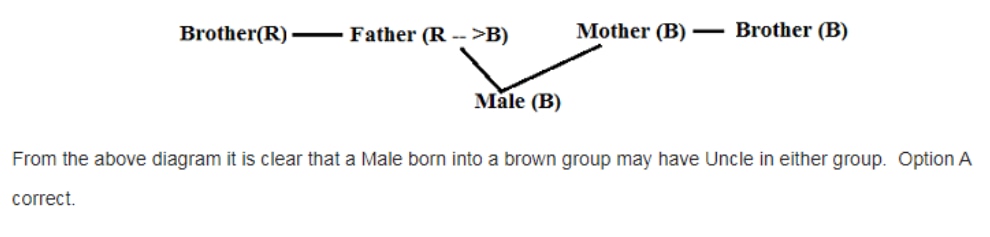
The male in question is born Brown, so at his birth his parents shared the Brown group. Since a wife keeps her own group, his mother was born Brown; since his father had to convert into Brown to marry her, his father was originally born Red.
Trace the father's side: the father's siblings (this male's paternal uncles) were also born Red, in the father's birth family. A paternal uncle who is currently unmarried, widowed, or divorced is still Red (his birth group); but if married, the endogamy rule means he married a Brown woman and converted to Brown. So a paternal uncle can currently be in either group, purely depending on his own marital history.
Trace the mother's side: the mother's siblings (this male's maternal uncles) were born Brown, in the mother's birth family. A maternal uncle who is unmarried, widowed, or divorced is still Brown; but if married, he converted to Red by marrying a Red woman. So a maternal uncle, too, can currently be in either group.
Either branch of the family can therefore supply an uncle in Red or in Brown, as a function of that uncle's own marital status — never fixed by which parent he descends from.
This matches the family tree traced outward from the male's own parents (see the diagram below): both the paternal-uncle branch and the maternal-uncle branch fork on marital status alone, so ‘either group’ is confirmed independently from both directions.
A daughter or son of this male cannot be Brown: to marry at all he — being Brown-born — must marry a Red woman (marriage within his own group is forbidden), and that marriage converts him to Red; every child he has afterward is born into the Red group he and his wife then share, never into his original Brown group.
A son-in-law cannot be born into the Red group either: this male's own daughter is Red-born (per the point above), so by the same endogamy rule her husband must originate from the opposite group, Brown, and only converts to Red after marrying her — his group at birth is Brown, not Red.
So among the four possibilities, only an uncle in either group is genuinely guaranteed — his children can never be Brown, and any son-in-law of his is Brown by birth, not Red.