Two positions of a cube are shown below. When the number 4 will be at the…
2025
Two positions of a cube are shown below. When the number 4 will be at the bottom, then which number will be at the top?
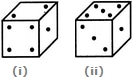
- A.
3
- B.
5
- C.
6
- D.
can't determine
Attempted by 2 students.
Show answer & explanation
Correct answer: A
In a cube/dice reasoning problem, three faces are visible in each drawn position — top, front, and right (or left) — while the other three (bottom, back, and the remaining side) stay hidden. Every cube has exactly three pairs of opposite faces: Top-Bottom, Front-Back, and Left-Right, no matter how it is turned. When two different positions of the SAME die share one common number on the same visible face, that face can be used as a fixed pivot: the remaining four faces then form a single ring that only rotates as the die spins about that pivot axis, so their arrangement in one position must be a cyclic rotation of their arrangement in the other. Matching that ring reveals every hidden face, and hence every opposite pair.
Reading the pips in the two given positions:
Position | Top | Front | Right |
|---|---|---|---|
(i) | 2 | 4 | 1 |
(ii) | 5 | 3 | 1 |
The number 1 sits on the right face in both position (i) and position (ii), so it is the common pivot face.
The digits actually shown across both drawings are 1, 2, 4 (position i) and 1, 5, 3 (position ii) — together 1, 2, 3, 4, 5. The one digit never shown, 6, must therefore be the hidden left face, opposite the pivot: 1 is opposite 6.
With the right face pinned, the other four faces (top, front, bottom, back) rotate together as one ring when the die turns about the right-left axis. Position (i)'s ring starts top(2), front(4), then two hidden faces from the leftover digits 3 and 5. Testing both orders, only the ring (2, 4, 5, 3) rotates into (5, 3, 2, 4) — exactly position (ii)'s reading of top(5), front(3). So in position (i), the hidden bottom is 5 and the hidden back is 3.
Since top-bottom, front-back, and right-left are always the three opposite pairs of a cube, position (i)'s completed layout gives: 2 opposite 5, 4 opposite 3, and 1 opposite 6.
Every pair found — 1 and 6, 2 and 5, 3 and 4 — sums to 7, matching the standard convention used for a regular die, which confirms the layout is consistent.
An opposite-face relationship never changes with orientation, so wherever 4 is placed, 3 always sits on the exact opposite face. When 4 is at the bottom, 3 must therefore be at the top.