Two positions of a block are shown below. When 2 is at the bottom, which…
2025
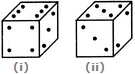
Two positions of a block are shown below. When 2 is at the bottom, which number will be at the top?
- A.
1
- B.
4
- C.
6
- D.
can't determine
Attempted by 4 students.
Show answer & explanation
Correct answer: A
Concept: In a two-position cube/dice problem, if the same face-value shows in the identical position (here, the top face shows the same value) in both drawings, the two drawings are the SAME cube seen after only a rotation about the vertical (top-bottom) axis. Under such a rotation the four side faces (front, right, back, left) simply cycle around that axis, while opposite-face pairs — (front, back) and (left, right) — never change; once the cyclic order of the four side values is fixed, any two opposite faces can be read off directly.
Application:
Position (i): front face = 4 (dots at the four corners), right face = 2, top face = 6.
Position (ii): front face = 3 (three dots on a diagonal), right face = 1, top face = 6 — the same value as the top of position (i), so the two drawings are one cube, turned only about the vertical (top–bottom) axis.
A turn about that axis can only be 0°, 90° clockwise, 90° anticlockwise, or 180°; testing each against the two fixed values — front(i) = 4 and right(i) = 2 — is enough to rule out three of them:
Turn | Would need front(ii) = | Would need right(ii) = | Consistent with observed front(ii)=3, right(ii)=1? |
|---|---|---|---|
No turn (0°) | 4 | 2 | No |
90° clockwise | 2 (old right) | back(i), unknown | No — front(ii) is 3, not 2 |
90° anticlockwise | left(i), unknown | 4 (old front) | No — right(ii) is 1, not 4 |
180° | back(i), unknown | left(i), unknown | Nothing yet contradicts it |
Only the 180° turn is left standing, so it must be the real one: back(i) = front(ii) = 3 and left(i) = right(ii) = 1.
In any cube, left and right are one of the three opposite pairs (with front–back and top–bottom). Since right(i) = 2 and left(i) = 1, the number 1 sits directly opposite the number 2 — always, regardless of which face is up.
So turning the cube until 2 faces the bottom brings 1, its opposite face, to the top.
Cross-check: Elimination left exactly one surviving turn (180°), so back(i)=3 and left(i)=1 are forced, not assumed — swap the roles and check position (ii) directly: its back must equal position (i)'s front (4) and its left must equal position (i)'s right (2), which is consistent and repeats no value on any single drawing, confirming 1 is opposite 2.