Directions: A cube of side 10 cm is coloured red with a 2 cm wide green strip…
2026
Directions: A cube of side 10 cm is coloured red with a 2 cm wide green strip along all the sides on all the faces. The cube is cut into 125 smaller cubes of equal size. Answer the following questions based on this statement: How many cubes have at least one face coloured?
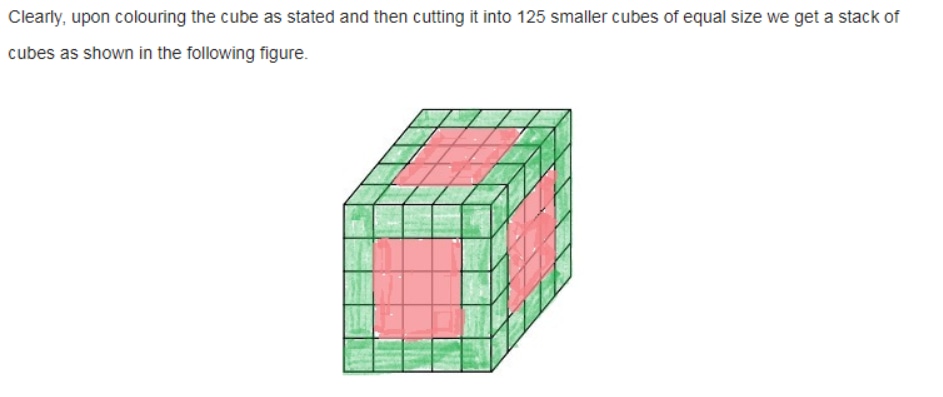
Answer: C. 98 — Concept: when a cube's entire outer surface is painted (in one colour or a combination of colours) and it is then cut into n3 equal smaller cubes, a smaller…
- A.
100
- B.
95
- C.
98
- D.
99
Attempted by 15 students.
Show answer & explanation
Correct answer: C
Concept: when a cube's entire outer surface is painted (in one colour or a combination of colours) and it is then cut into n3 equal smaller cubes, a smaller cube is left completely unpainted only if none of its six faces lies on the outer surface — that happens exactly for the cubes forming the innermost (n − 2) × (n − 2) × (n − 2) block. So the count of smaller cubes with at least one coloured face is n3 − (n − 2)3.
The cube of side 10 cm is cut into 125 = 53 equal smaller cubes, so each edge is divided into n = 5 parts and each smaller cube has side 10 ÷ 5 = 2 cm.
The 2 cm-wide strip runs along every edge of every face, and each smaller cube's edge is also 2 cm — so the strip exactly covers the outer ring of the 5 × 5 grid on each face, while the red covers the remaining inner region. Together the red and the green paint cover every face completely, so every smaller cube touching the outer surface has at least one painted face — its colour does not matter for this count.
The completely unpainted smaller cubes are exactly the innermost block: (n − 2)3 = (5 − 2)3 = 33 = 27.
Cubes with at least one face coloured = total cubes − unpainted cubes = 125 − 27 = 98.
Cross-check: classifying the 5 × 5 × 5 cube's outer-layer cubes directly gives the same total — 8 corner cubes with 3 painted faces, 12 × (5 − 2) = 36 edge cubes with 2 painted faces, and 6 × (5 − 2)2 = 54 face-centre cubes with 1 painted face: 8 + 36 + 54 = 98, confirming the result.
